
“I want food that don’t make me sick, I want walls that hold back the wind. I want a good life.” Edward Kenway’s introduction to piracy isn’t inspired by dreams of wealth or a longing for glory. He simply wants to live comfortably, out of poverty. The Welsh privateer-turned-pirate never meant to get embroiled in a conspiracy between Assassin buccaneers and Templar admiralty; he was simply a victim of fate. But being an instinctive survivalist, a canny opportunist, and a wanton gadabout, it turns out a life at sea suited him just fine. It’s a tale as charmingly simple in 2026 as it was in 2013.
And that’s why I’ve got so much patience for Black Flag Resynced. You might think a remaster of a game from only 13 years ago is a bit unnecessary – after all, Assassin’s Creed 4: Black Flag still holds up fairly well, and you can currently play the sixth entry in the series on modern consoles with relative ease via Ubisoft +. But, in actuality, the game shows its age. The open world is beautiful, but deceptive. Atolls and islands tease life and exploration, but hide one measly chest of booty, surrounded by nothing. Plot threads spin up, unravel, but often end up getting snipped off without a satisfying conclusion. Kenway’s chaotic piratical nature always felt a bit at odds with his suspiciously Assassin-like way of fighting, leaving a sense of disconnection whenever melee broke out.
There was clearly a lot that Ubisoft wanted to do with Black Flag that its two-and-a-half-year development cycle didn’t allow for. So, in going back to it, Ubisoft Singapore is making good on some very old promises. Resynced retains the original’s world structure and narrative layout, but rebuilds the environments and character models. It picks out the parkour and combat, and rethinks them in a way that’s more aligned with the fiction of the world it’s set in, rather than feeling like ‘just another Assassin’s Creed game’. It introduces 13-plus years of water and simulation technology to make the ocean feel like a real entity in its own right.
But, as ever, there’s a catch. I’m told the game has been “built from the ground up in the latest version of the Anvil engine”, the same tech powered the still-stunning Assassins’ Creed Shadows. I was expecting Resynced to be Assassin’s Creed Shadows with a Black Flag skin, but it’s not. Certain textures are a bit off, and can pop-in or smear as cutscenes morph to gameplay. And there are quirks to the physics that I can’t quite explain. Using a rope dart (think Scorpion’s get over here from Mortal Kombat) would often pull an unsuspecting British naval officer off a ship into the ocean. Cool. But sometimes, the officers would find themselves suspended in the air for a second, fall over nothing, then get back up like nothing had happened. Sometimes your camera would start panning away from you for seemingly no reason in the middle of a tense crawl through long grass as you try to sneak up to a plantation house to nick a key from some capitalist toff.
Yet, I’m actually quite charmed by how wonky everything is in this game; the occasionally bizarre physics, the loose and glitchy camera… maybe it’s because I’ve such an affinity for the original game, but it all sort-of works for Kenway. He’s a messy man, a raucous fighter, an anti-hero. We’re playing (if you want to go way back) in a simulation of a simulation; if I wanted to be glib, I could explain these glitches and bugs away as ‘quirks of the Animus’ and suggest even that Ubisoft intended for them to be there as a part of a four-dimensional meta-narrative, or something.
Black Flag is a looker, for sure, but the edges of the Animus are a bit frayed.
But neither you nor I are that naive. We can call this what it is: a modern engine struggling with the legacy of a 13-year-old game. Resynced is a very different beast to Shadows. In Ubisoft’s own words “there are no levels, no gear scores and no progression gates”. Combat has not been designed around damage numbers and modifiers. As such, crammed into the Shadows engine like it is, combat feels, for lack of a better word, shonky. But there’s a roughness to it that reminds me of the more chaotic action-adventure games of the 360 generation, something from that Arkham Asylum/Brutal Legend/Prototype spectrum. You glue to an enemy, you shoot or stab them, you move on. Parries are over-powered, and you don’t get to use your hidden blade in combat because you’re not really an Assassin. Good! Instead, there are all these improvised pirate tools stuffed in your pockets, and each one apparently has a low-percentage chance to overwhelm the physics engine. Yes! Chaos! It’s like being in 2013 again (complimentary).
There’s a self-seriousness to most Assassin’s Creed games that I actually find endearing, but Black Flag was always the odd one out: you don’t actually play as an Assassin, you spend more time in a ship than you do scaling walls, and your main character is a mouthy gobshite more interested in hedonism than ‘Apples of Eden’ or ‘The Observatory’. The slightly wonky graphics, engine-work, and combat in Resynced feel right for him. It’s like you’re experiencing the game through a rum-induced hangover at Kenway’s expense. I didn’t even mind that, mid-way through a pretty important narrative cutscene where you’re introduced to famous female pirate Anne Bonny, everything just became underwater as the ocean glitched over, then around, the ship. Big bugs like that may well be stamped out by the launch of the game, but there’s a lot of engine-side goofiness that feels pretty baked-in, to me.
Is Black Flag Resynced as egregious a remake prospect as something like The Last of Us? I don’t think so. There’s more going on here; there’s meaningful development to the Caribbean world, there’s more texture added to the Golden Age of Piracy, there’s more agency and fantasy for you to get lost in. So what if the choppy waters of the sea sometimes wash you away mid-cutscene? So what if the lock-on is either too sticky or too loose in combat? There’s a charming shonkiness to this game that befits Kenway and his clumsy half-smirk.
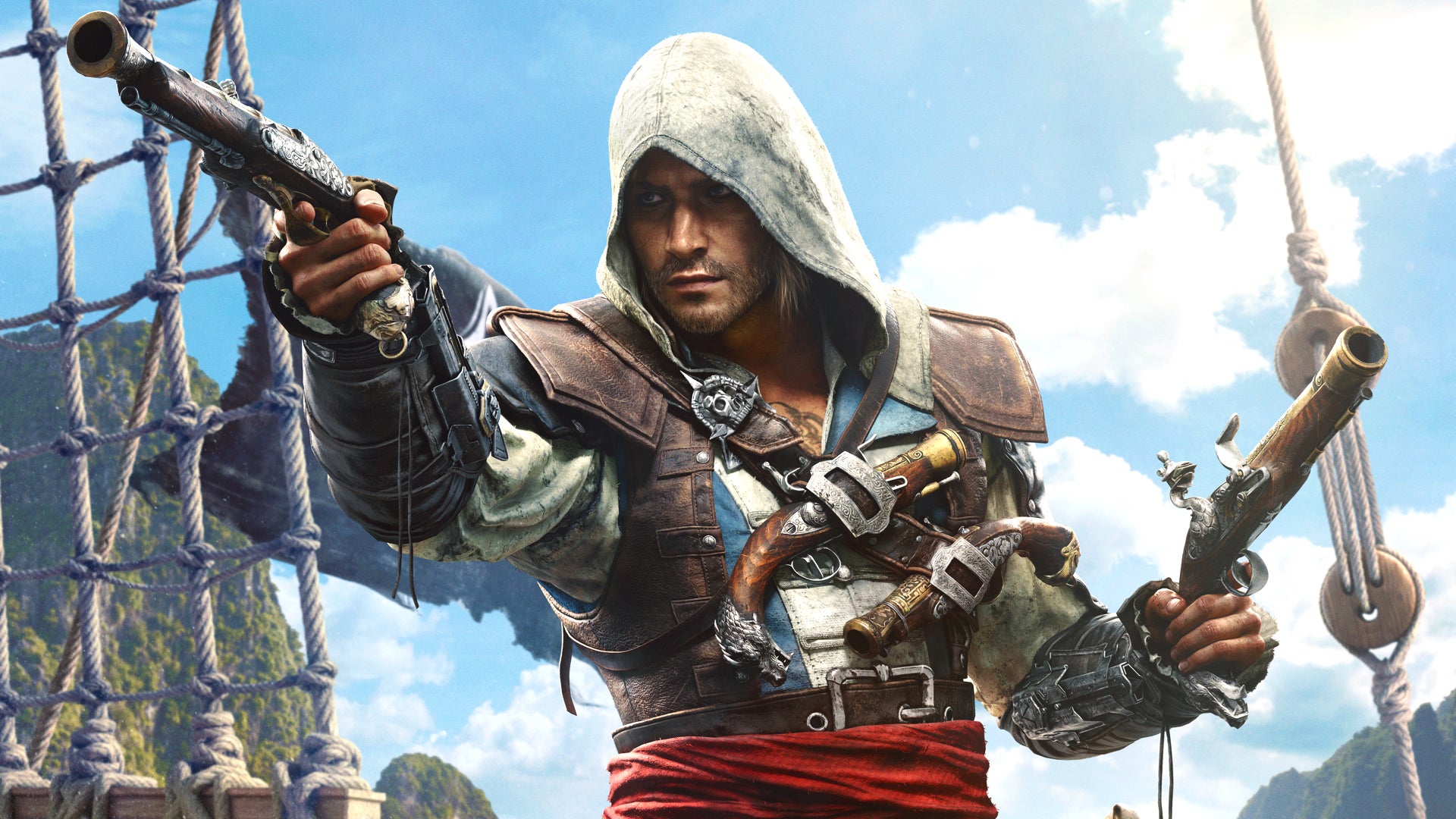
It almost feels as if Ubisoft has tried to force the old bones of 2013’s Black Flag into a well-tailored buccaneer outfit from 2026, and reanimate the corpse inside before shoving it out on-stage to dance for us. In a sense it’s macabre, but I find myself fascinated by the implications of it. In bolting on so many bells and whistles, Resynced actually highlights many more of the weird game development philosophies of those borderline seventh- and eight-generation console games. The imperative ‘go here, do this’ open world formula that Ubisoft was so roundly mocked for a decade ago now feels pleasantly nostalgic – but perhaps that’s because there’s more to actually do on the map, and each island isn’t just a procedurally-generated facsimile pretending it has something for you to find.
This is a remake, then, that justifies itself the more you dig into it. And because of the depth that becomes more apparent the deeper you dive, I can forgive the graphical peculiarities and engine quirks that crop up here and there. I went into Black Flag Resynced dubious, but left charmed by Ubisoft’s clear understanding of what makes this one of the most enduring entries in the Assassin’s Creed oeuvre. If this is the template Ubisoft plans to use when revisiting the rest of the AC catalogue, then – like an unsuspecting Welshman about to get swept up in a global conspiracy – I’m tentatively onboard. Having seen the backlash against those infamous Unity bugs, though, I get the feeling I might be in the vast minority here. I wonder how much of this can be addressed before the game launches in early July.


