
Coffee Talk started out as a slice-of-life visual novel casting you as a night-shift barista serving Seattle’s uniquely magical residents, from elves to vampires to succubi, hearing out and advising their whims and woes over steaming cups. Its strength was not just in the individual lines of dialogue spouting from these monsters (affectionate), but also in how those were placed within the context of Magical Seattle: a thread of societal distaste towards interspecies relationships, for example, is held taut through several characters’ arcs, not just in the two characters whose parents explicitly disapprove of them for it. Opinions and arguments towards the ills facing this world are treated with the weight they deserve, acknowledging the fluidity of both public opinion and the problems themselves.
It’s a slightly heavy-handed metaphor for racism, sure, but that doesn’t make it much less effective; societal bigotry is a compelling story element because most people (especially Coffee Talk’s intended diverse audience) have experienced it in some way. Episode 2: Hibiscus and Butterfly was comfortable with building on this strong framework rather than reinventing it, though it did introduce new customers and new societal issues to approach, such as the inclusion/alienation of marginalised peoples and mass layoffs (forever relevant, it would seem). It doesn’t shoot for the moon in its commentary, but it says what it sets out to say clearly, and ties that commentary into its characters’ lives and struggles similarly to the first. You’re invested in the world because you’re invested in the characters, and vice versa.
Coffee Talk Tokyo abandons Magical Seattle for Magical, um, Tokyo. Considering its placement in the game’s title and being the first ‘new’ locale in the series, you might assume that the third game is attempting something different: approaching societal issues not just from a new angle, but from a new national culture entirely. A stage set to entwine the specific issues faced by dragons, kappas and yuki-onna — magical creatures uniquely drawn from Japan’s mythology of yokai — with the contemporary issues facing Japan, just as the previous games reflected the realities of America through this fantastical lens. Coffee Talk Tokyo, unfortunately, does not.
It’s set in Tokyo, undeniably, and there are many small reminders of that fact recurring throughout the game; the problem arises in how little this Japanese flavour actually matters to the setting or story. Characters speaking in English will sprinkle the Japanese honorifics -san, -chan, and -kun into their speech quite inconsistently, feeling more like cultural window dressing than an attempt to represent the nation’s language. ‘Senpai’ is used in place of ‘boss’ for no discernible reason other than because it’s a Japanese word. A child of English and Japanese parents begins to make an almost touching point about being stuck between two cultures, but is sadly denoted as ‘the child character’ and thus not permitted to expand on this empathetically. Many, many, far too many comments are made about the insufferable summer heat beaming down on the city, with several days beginning with the barista bemoaning ‘Gosh, this heat…’ or a similar stock statement, yet no interrogation is performed into why the Tokyo heat is quite so painful, or the very real effects of heatstroke on the Tokyo workforce.
One of the most frequently returning cafe regulars is a kappa salaryman, Kenji, who inhabits the ‘overworked and stressed middle-aged salaryman’ stereotype seen across both Japanese media and media about Japan equally. He fits this like a glove, setting alarms both to sleep and to wake up, making self-deprecating jokes about not being there for his wife, and losing purpose when he loses the job that defined his daily life. But it stops there. Coffee Talk Tokyo has no interest in pursuing the threads of how Japan’s strict and strenuous overwork epidemic could affect him, prospectively obliterating his mental wellbeing or driving him to suicide, as is depressingly not an infrequent occurrence for many in the white-collar workforce.
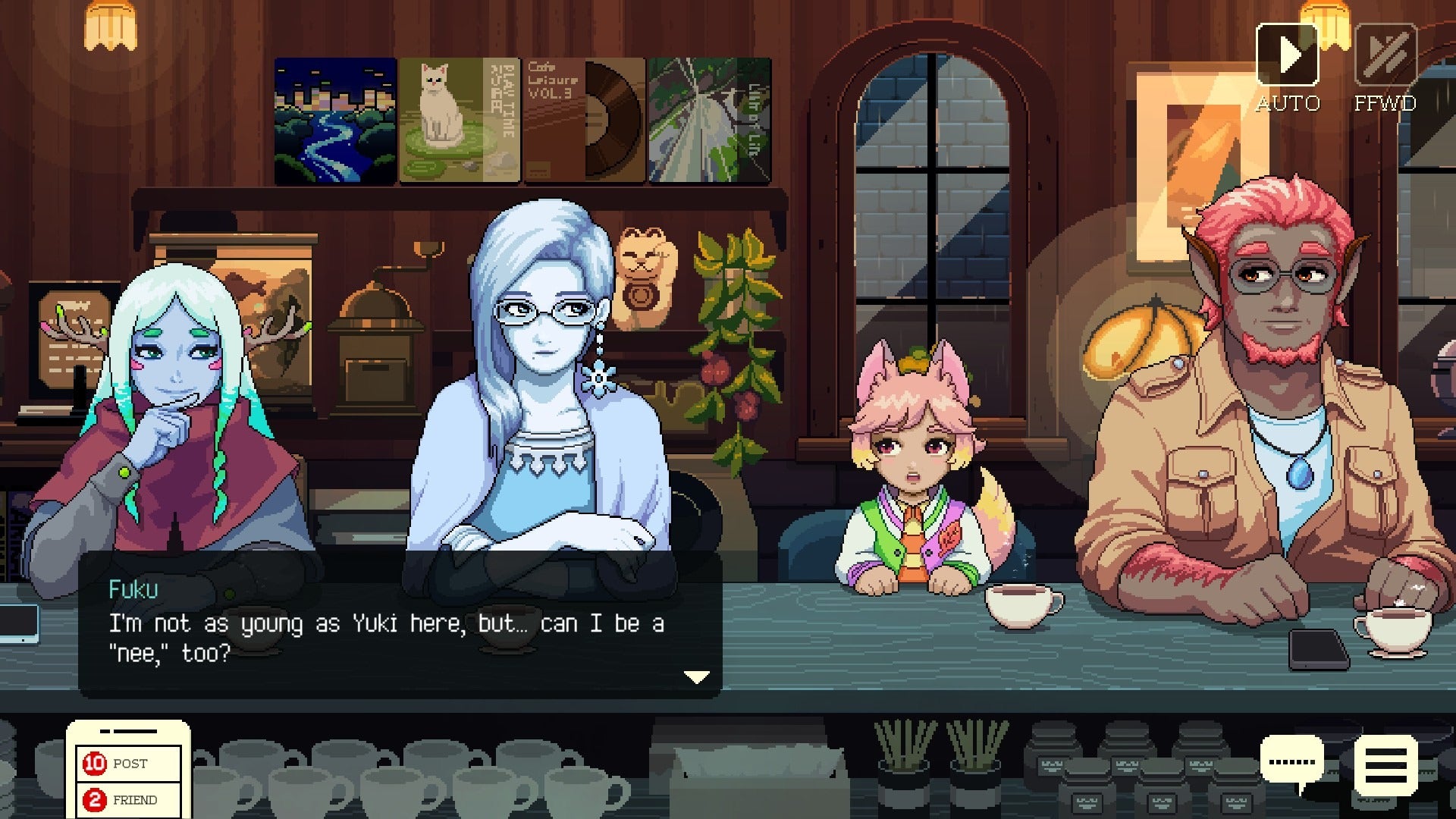
It’s perhaps the single most Japan-specific thread to pull on, one that would be effective specifically within Coffee Talk Tokyo’s new setting where it wouldn’t make as much sense in Seattle. But it’s seemingly avoided for being too dark, too real. It doesn’t fit the cosy collection of stereotypes sitting at the cafe’s counter, the warm and whimsical feeling produced by the barista’s presence. It’s painful to be in a real place with real issues.
The reason for this is tied to Tokyo being front and centre in the game’s title, the defining aspect of this entry: Toge Productions is selling this game based on your love for Japan. Not for Japan in its reality, in its aforementioned societal ills and people being overworked to death – not that Japan. No, Coffee Talk Tokyo sells itself through the rose-coloured lens of Japan through anime, manga and games; the filtered, saccharine, disconnected view that non-Japanese audiences most often see it through. Orientalism never went away, it’s just been twisted into a selling point for many disinterested in what Japan is, who would rather see it through appropriation via its cultural exports. Despite being an Indonesian studio and thus not fully embedded into American culture, the position of America as a universally known entity (and the constant barrage of information placing it at the centre of the world) meant Toge’s writing of Seattle could be relatively based in reality, with the complexities that come with setting a game willing to interrogate culture in the ‘land of the free.’

Japan’s inclusion in Coffee Talk Tokyo is the platonic ideal of the country’s ‘Cool Japan’ strategy: a magical place filled with bright lights, enriching culture, and the uncomfortable parts of its society swept under the rug. It’s an aesthetic, not a setting. Why actually delve into the use of Japan as a setting when it’s much more palatable to simply add a stencil of a Torii gate to decorate lattes with? Don’t you guys love Tokyo? Like from Yakuza?
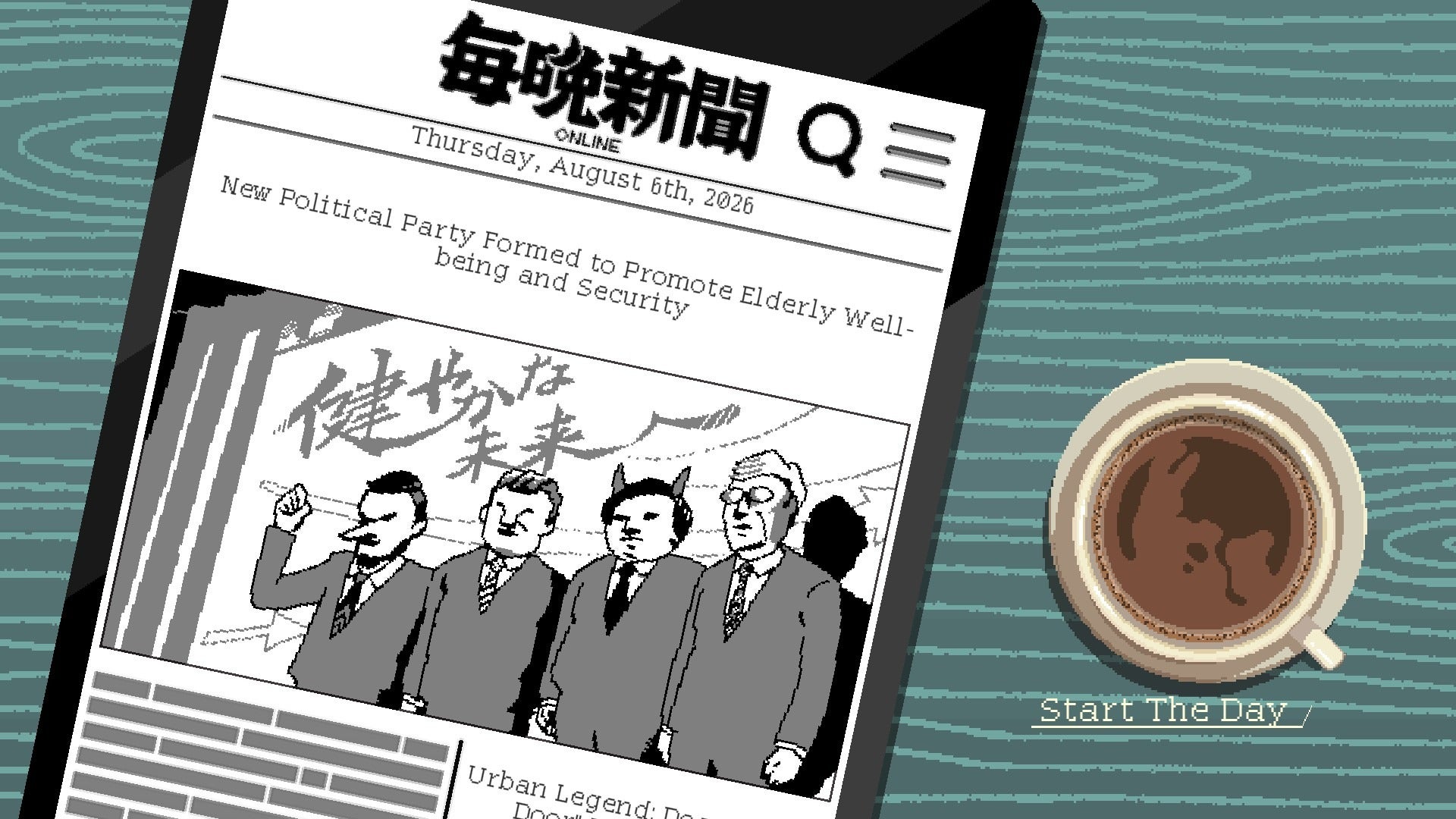
What makes this sting a little more is that scattered throughout, there are hints of what the game could be tackling, in the form of local newspaper front pages that appear in the empty space between workdays. Headlines like ‘New Political Party Formed to Promote Elderly Wellbeing and Security’ or ‘What Does Faith Mean in the Modern Age?’ imply a level of societal commentary regarding Japan, in the prioritisation of the notably high average age of the population and the ebbing belief in Shinto across the nation, but go no further than these literal headlines.
By limiting these questions to just a single sentence seen between days filled with conversation, Coffee Talk Tokyo squanders the opportunity to explore these societal concerns within its dialogue – the main body of the game – in place of fleeting gestures, scared to go beyond the surface level and broach the more difficult and complex aspects of setting a game in contemporary Japan. It’s ironic to consider that Coffee Talk was originally inspired by Midnight Diner, a Japanese TV series that grants the game its structure (just in a cafe rather than an izakaya), and yet the entry actually set in Tokyo is the furthest from the show’s touching and honest explorations of the realities of Japanese living for all walks of life.

For a (literally) more cultured perspective, I spoke to Fernando Damas: writer of VA-11 Hall-A, fluent Japanese speaker, and resident of Osaka for about a decade. While I did ask questions for simple accuracy, such as regarding the use of honorifics – “Honorifics in an English dub have a place… to reinforce the setting [as] explicitly ‘Japanese'” – I was most interested in the process of writing a setting inspired by Japan and Japanese media, as VA-11 Hall-A’s Glitch City initially began, and the inclusion of social and societal commentary within. He felt that societal commentary of real places is more of a “consequence” than a responsibility, but that what matters is for that commentary to be slot into the context of the story being told, which can teeter into irresponsibility if handled clumsily; that said, he expanded that stories also “have the license to handwave things within reason to focus on their main point (a single story can only do so much, after all), but it stands to reason that commentary would, by necessity, cast a light on less fun elements.”
Faced with the prospect of writing a Japanese setting, Damas emphasised the importance of being “cognisant of just how different my upbringing is… If there’s ever such a thing as appropriation, I would say it’s the point where you position yourself as if you come from that first-hand-upbringing place and speak for them.” As someone who grew up in Venezuela and incorporated that experience into Glitch City’s dystopia, he admitted that an “unexpected consequence is that the [writing] process ends up reducing the complexities of growing up in specific circumstances into a similar thing.” To avoid positioning himself and speaking for others, he would “try to get a feel for how things are there. Every country has (for lack of a better word right now) a vibe on top of its identity which informs a lot of things,” and noted that “if the mood is right and the audience has good will towards you, a lot of details can be gladly handwaved as a fun quirk” – precisely what Coffee Talk Tokyo attempted with its representation of Japan, hoping to ride the goodwill of its previous entries with a shiny Japanese veneer.
One of these details, the issue of overwork being deeply ingrained in culture, was illustrated by an unexpected place: advertisements for officewear. “Inner soles that are extra comfortable in your shoes, shirts and pants with the sort of breathing fabric you only hear about in sportswear, and so on,” Damas recalls. With how “deep-rooted” the expectation to overwork is, it’s “easier to accommodate” than to change at a national level; Damas commented that this being the “baseline” of “shocking hours” that the country operates in makes it “all the more daunting” that companies overwork employees even by that concerning baseline. There’s a touch of gallows humour in that these advertisements’ message is implicitly “You’re going to spend most of your life in these clothes, might as well have fun!” Despite the inclusion of Kenji, Coffee Talk Tokyo chooses not to touch this difficult and salient topic with a ten foot pole for fear of damaging the idealistic, surface-level view of Japan it presents.
Setting a story in a real place, rather than a world made up anew with its own author-set rules, is a choice that inherently comes with the weight of that place’s history, issues and oft-painful reality. Coffee Talk Tokyo has no interest in any of this beyond the Japan that exists in the lens of popular culture: a comfortable and fun version, rid of its complications as a real country with issues just like any other. It’s Japan for those people in your life who always seem to inexplicably be able to visit it, referring to it as ‘another world’ and, probably, ‘the land of the rising sun.’ Orientalism, made cosy.


