
When I wrote, barely six weeks ago, that I liked to occasionally re-read Tom Bramwell’s “Microsoft kills game ownership and expects us to smile” editorial to remind me what it’s all about, I didn’t mean I wanted to actually re-write a tribute act version of that article myself. I also didn’t mean I wanted to be writing something like it so soon after bringing it up. And I definitely didn’t mean I wanted to have to re-write it not once, but twice, within the space of a few days. I already had to take one stab at it just last week, as the impervious Rockstar nudged the first domino in the ultimate collapse of physical video game media. Now, it’s Sony’s turn. Only this time it’s the big one.
There will be no more new PlayStation video games printed on discs from 2028, from any source. There will most likely be no disc drive with a hypothetical PS6, a console that’s increasingly likely to cost in the region of $1,000, mainly because there will be no physical games to play on it (apart from all your previous-generation ones, of course, but come on now). And by virtue of all that, the concept of “game ownership”, the notion of buying something and actually owning it, it being yours to keep and share and sell and preserve forever, not just be rented indefinitely until someone arbitrarily decides to disappear it from your library in the click of a finger – like, oh I don’t know, all 551 movies made by Studio Canal – is effectively gone.
It has been mostly gone already, of course. You don’t own your PC games on Steam or Epic (and Steam was arguably the start of all this, it shouldn’t be forgotten). You won’t own your PlayStation games once they can’t be bought on a disc – and discs are, as preservation experts have pointed out, only a part of the puzzle here too, with the disc-as-a-license concept the real issue. You sort of maybe own your Nintendo games on a “game key card”, insofar as it’s an unresolved question as to whether you can have the license to one revoked – but you can at least sell them on. And you don’t own your Xbox games because, let’s be honest, on the balance of probabilities you probably don’t own an Xbox.
That might seem like a stray potshot for poor old Team Green, but there is a point to be made here. Not to absolve Sony of responsibility for its own grim decision-making – this is not Xbox’s fault, although, never ones to miss out on a good self-own, they look to be joining in anyway. But is worth asking: would this decision have been made if Sony had any serious, viable competition from their one-time rival? Xbox’s attempts at standing up to PlayStation have been so utterly, pitifully impotent over the past decade – this slash-happy present administration very much included – that Sony now essentially has free reign over the high-end home console market.
There was a time when Xbox, even as it faltered in so many ways, at least drove a genuine movement in favour of the consumer. Under former boss Phil Spencer, cross-play between Xbox and PlayStation, cross-save from Xbox to PC versions of the same game, and backwards compatibility across generations were all primarily Xbox initiatives, all driven by a competitive desire to make one platform a better place to play than another, or to win the PR war, or to at least keep the pressure on the front of the pack, even if it couldn’t be overtaken yet.
“Killing off physical games leads to a lack of competition as well. And a lack of competition has effects that bleed into the entire ecosystem…”
With that competition essentially done, the brief puff of good will Xbox elicited from its summer showcase immediately swept away on the wind of yet more goblin green corporate savagery, there’s vanishingly little incentive for Sony to care about the farther corners of consumer experience. Or just whether it comes across as a bit evil. It’s worth making it clear here: if physical games are on the chopping block, after PlayStation executives themselves once stood on stage and evangelised their benefits for the world to hear, then nothing is sacred. If you break the biggest norm, all the little ones can be broken too. Anything from backwards compatibility to established pricing can and will be on the table now.
It also ties into one of the biggest issues, of several, that will arise here. Killing off physical games leads to a lack of competition as well. And a lack of competition has effects that bleed into the entire ecosystem. Consoles are already relatively walled gardens, but by making the purchase of games all but exclusive to a transaction on the platform itself, Sony is essentially achieving peak vertical integration, the wettest of corporate dreams. And we have to assume that exclusivity will be the case; I don’t see a great deal of appetite for empty retail boxes, nor much reason to buy a code from Amazon or your trusty local brick-and-mortar holdout over the PlayStation store itself, with its Plus member discounts and direct-to-consumer advertising.
Walled gardens typically mean a couple of things: nice, smooth processes for buying and downloading stuff, at the cost of worse deals for developers, higher prices, and reduced consumer rights for those who do the buying. You need only look at console platforms themselves for a taste of it, with the rent-seeking practice of demanding a continuous – and not cheap – subscription to access relatively basic features of modern gaming such as cloud saves or online multiplayer. Then you can look at the size of the cut taken from developers by Steam or Apple, for good measure.
That’s only the start of it. Binning off discs has all kinds of consequences. Preservation is the obvious one – and yes, discs have long since passed being the panacea here, with the rise of day zero patches, always-on internet requirements and relentlessly updated games. We’re no longer in the world where buying a physical copy of a game even means you own it anyway, let alone that you own the best and final version of the game – often quite the opposite.
But there are both practical and symbolic losses here that come with their demise. With the rise of continuously updated games, for instance, an object that preserves their original form at launch becomes a genuine artifact. This is the thing that stores the version of Crimson Desert that reviewers played; the version of a game with, say, all the licensed music that’s since expired (hello again, GTA 6); the version of Cyberpunk 2077 with the historically disastrous technical issues that shook an entire industry; the version of Mass Effect 3 before the scale-tipping moment where developers changed the ending players didn’t like. It’s easy to dismiss history when you’re in the middle of it, but if we want to treat video games like the grown up medium it wants to be then we are obliged to care.
“There is something intangible that goes away here… a sense of connection with what you love.”
Then there’s the concept of game sharing that Sony is also obliterating here, the irony of which has, naturally, been pointed out ad nauseum over the hours since the news broke. In case you missed it: it was PlayStation, 13 years ago, that mocked Don Mattrick’s Xbox One DRM plans so perfectly with an off-the-cuff video recorded at E3 2013. And it was Sony Interactive Entertainment’s then CEO Jack Tretton who stood on stage at that E3 and said, amongst interrupting cheers from the crowd: “We believe in the model that people embrace today with PlayStation 3 and continue to demand… when a gamer buys a PS4 disc, they have the rights to use that copy of the game. They can trade in the game at retail, sell it to another person, lend it to a friend, or keep it forever.” The problem with using principles to land a big PR punch of course is that when you abandon them, that punch tends to swing back around twice as hard.
With physical discs gone, so is the second-hand market – a disaster for many high street retailers – and with it the ability to actually maintain value in what you buy as a consumer. Forget the loft-storage treasure trove discovered years down the line – there’s no longer even a guarantee that any old console you dig out from under all the old school homework your mum kept in deep storage will even play the games it has stored on it. And speaking of storage: please look forward to the all-digital future where an SSD costs up to $3,000.
There’s more! And I think, actually, this might be what matters most. There is something intangible that goes away here. About a year ago, on a spare afternoon in Helsinki after visiting the wonderful Remedy, I went to the Oodi, Helsinki’s central library – a “gift” to the people of Finland to celebrate the 100th anniversary of its independence.
It’s an extraordinary building, squared off with machine precision at each edge, but then on top of it a rippling wave of wood and glass, like a rectangular, three-dimensional cross-section of the ocean and its bed has been cut out and placed, by a great environmental artist in the sky, in the middle of an open square. Inside – where it always seems to be bustling – it has a cinema and meeting rooms and study spaces and lots of books, of course, as well as 3D printers, craft areas, and a whole wall of musical instruments you can borrow to use in proper recording studios. And also: video games. Rooms of consoles, VR headsets, even a little CRT screen with some retro games.

On the top level, a glass-walled archive with a wooden floor that curves up at each end, as if to make you think you’re aboard some great ship bound for the arctic, you’ll find students sitting right up against the glass in the highest corners and families letting kids blow off steam in the little play area. And you’ll find games you can borrow to take home with you, in amongst the comics, graphic novels, and non-fiction books on photography and history and architecture. I remember sitting on this floor for a while, looking out over the greyness of the city, thinking I’d found utopia.
The impact of this library on the business of video games is nonexistent. I would expect no corporation out there to care, none to factor this sort of thing into decisions about what does or doesn’t make business sense. And that is, ultimately, all that’s going on here. It’s a business decision: a tiny fraction of people buy video games on discs these days. It’s often cheaper and easier to buy a digital version, it’s the path of dramatically less resistance, and when you create these paths people follow them.
But this is also why Sony’s insistence that this is a choice made due to “consumer preferences”, or that it’s a necessity in order to “adapt to consumer trends”, sticks so uncomfortably in the craw. The notion of consumers “voting with their wallets” is a myth – nobody put the full consequences of any vote in front of the consumer here. Nobody said you can choose to own what you buy, or to give that up for a small discount and to be able to buy it a bit faster, while you have the controller in your hands. There is no conscious, weighed-up, specific choice being made by anyone. Only the gradual drip, drip, drip away of melting options over time. The slow erosion of the right to that exact choice, as discs became licenses in themselves, as more and more games required an internet connection to play, or patch after patch to be actually complete beyond launch, and as the high street gradually died.
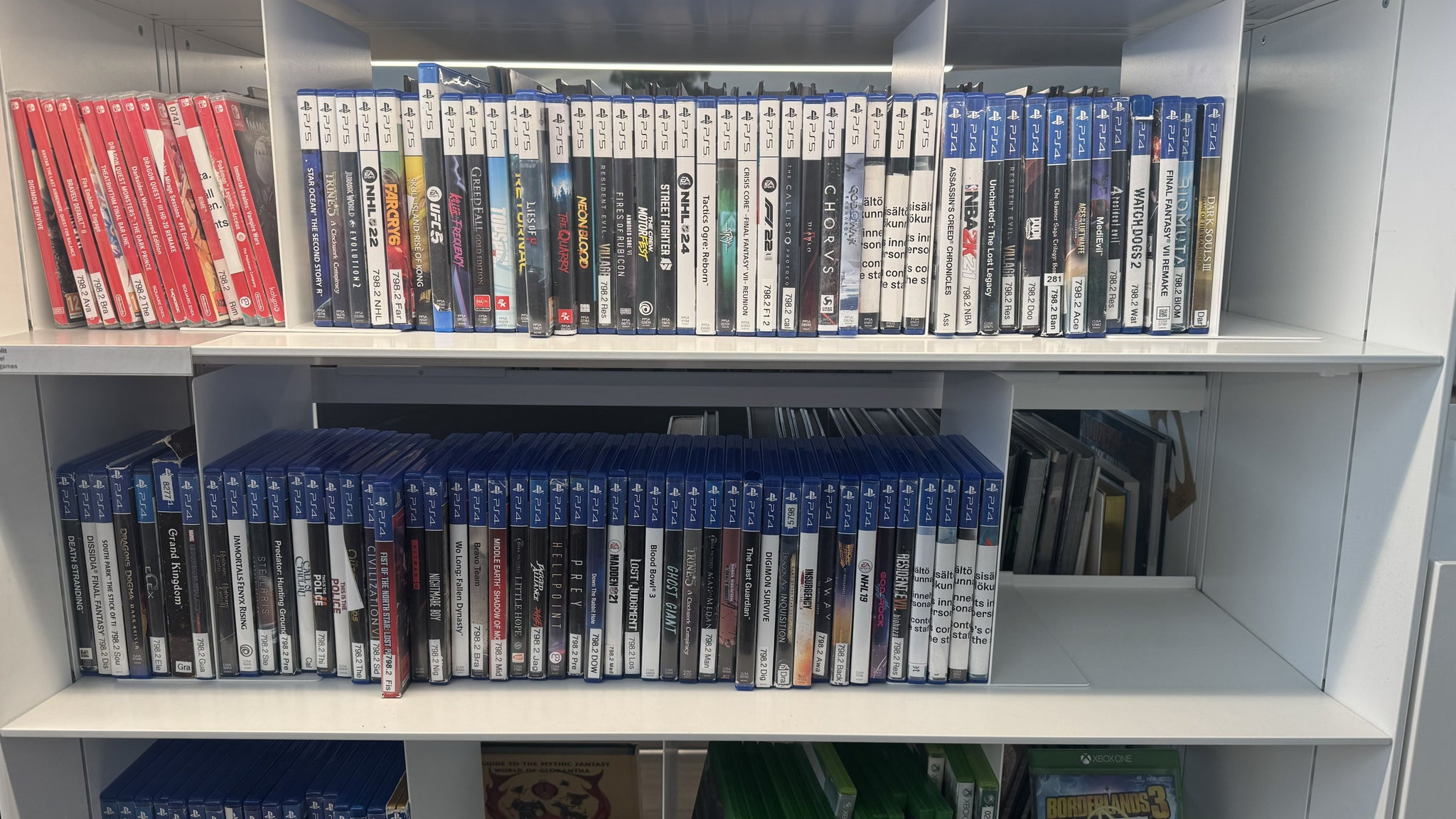
Some snaps of the library – I took these in the slightly optimistic hope of one day finding time to write a nice feature on the building.
People make purchasing decisions with short-term ideas in mind. They buy from the place, typically, that’s cheapest or easiest or fastest. But when people are tight on cash and their free time has been more aggressively eroded than ever before, the choice to do otherwise is only an illusion – and plenty of noise was made by consumers at each step of the way, at always-online and day-one patches and the rest. The idea of the ethical consumer – and placing the blame for corporate decisions entirely on the apparent lack of them – is one of the great PR achievements of the business world. The phrase ‘carbon footprint’ was invented by British Petroleum.
The real loss, as games move from the physical realm to the intangible one, is a sense of connection with what you love. A tangible, touchable, graspable thing that links you to all the people who made it. The chance to give that thing to another human, in person, and look them in the eye and tell them it’s brilliant. To go to a shop or a library or a friend’s house, out there in the real world, and browse its shelves. To ask an expert behind the counter for their advice, to make a trade at a car boot sale. To choose some fancy Criterion-style collector’s edition of that one, particularly special game, and put it on display in your home. What we get instead is alienation. A distance and a detachment, both from the art itself and the people who made it. This has no number attached that can be weighed or measured against the alternative. There’s no cost to moving humans further apart. But it is very much real, and it matters as much as anything, and you should let nobody in this world tell you it was your choice.


