
In July, I was given the opportunity to play 1666: Amsterdam, the newest game from Assassin’s Creed‘s original creator, smack dab in the middle (or rather, under) of the city where the game is set. And boy was it a tremendous experience, especially due to the game’s rigorous historical accuracy.
If you’ve played any Assassin’s Creed game from the first one up until Brotherhood, you will know that Patrice Désilets has a penchant for historical accuracy. I remember at 18 I visited Florence, Italy for the first time, and had an overwhelming sense of familiarity with the place, particularly its Santa Maria del Fiore church and plaza, precisely because of how devoted Ubisoft under his leadership was to faithfully recreating real-life locations.
And 1666: Amsterdam is no different. As you might have read in my thoughts on the demo, this game is set, as the name implies, in Amsterdam during the latter half of the 17th century. My journalist colleagues and I were given a tour of the town, i.e., of those locales that are to appear in the preview that we played later on, and once I finally got my hands on the game, everything really started to click.
We even visited the hotel from the start of the game (the one in the demo prologue), and going through it not long after in the prologue was a very, very strange experience. And I mean that in the best way possible.
The game’s world and city of Amsterdam are incredibly realistic, dense, living, and breathing, and that’s in many ways its greatest strength. Combined with the power of the Unreal Engine, it achieves a level of graphical fidelity and realism rarely seen in other games, though not many people are as obsessed with bringing the real world into video games as Patrice and his Panache Digital Games.
As for the gameplay, the preview picked up right after the prologue concludes. We got to control Noa and navigate the streets of Amsterdam (and its infinite rivers) and finally got a real taste of combat.
In the hands-off part, which I will cover in a separate article alongside interview questions, we also saw a good chunk of the game’s take on Amsterdam and how exploration will work, so stay tuned for that one.
It follows an over-the-shoulder, third-person structure, with Noa handling the fighting and Aaron, the cat, working in tandem with the witch to reach spots that Noa cannot, thus opening up new ways for her to traverse. This symbiosis forms the core structure of the game’s movement and exploration systems, though combat seems to lie solely in Noa’s hands.
Speaking of the combat, it unfolds mostly as a wave-based semi-Soulslike system, where militiamen and other enemies swarm Noa, who must perfectly dodge or parry their attacks and then unleash an onslaught of well-aimed broom swings. Furthermore, Noa can sneak up on enemies and destroy various parts of the environment, the explosion of which can instantly kill several enemies at once.
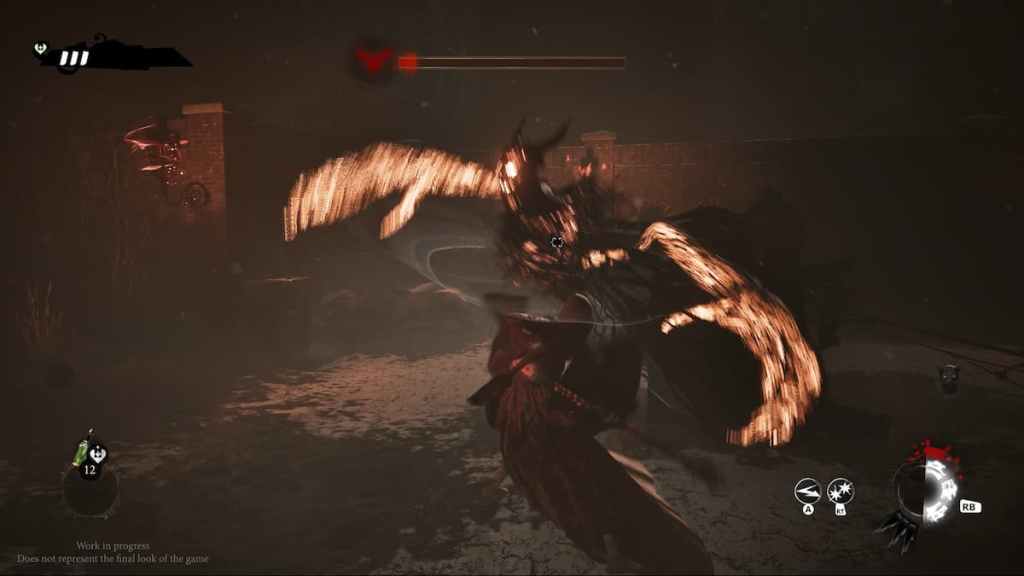
There is also an escalation system in place, with Noa fighting more and more powerful enemies depending on how many times she is detected and how many enemies she defeats during those combat encounters. I didn’t see many spells or witchcraft used in the preview I played, though in the hands-off with Patrice we were shown a roguelike-adjacent formula that gives Noa all sorts of tools for combat and traversal.
1666: Amsterdam has boss fights with story-crucial enemies that often transform into horrifying demons and harbingers of doom, and you have to fight them in true Soulslike fashion. Exploring the world, either by remaining a civilian or by transforming into a witch (can be done on the fly), nets you loads of materials for upgrades and healing, which you will then employ during your boss encounters.
Bosses are, as I’ve said, really straight out of the Soulslike manual, with dodging and learning attack patterns being crucial to taking them down. With so many healing items acquired around the world, the fight I saw wasn’t that difficult, but I was led to believe bosses vary drastically in challenge, with more powerful ones coming the further you get.
About the story, since the preview was so brief, I cannot comment much on its quality. The writing was neither here nor there, but that is yet to be judged once I have the chance to actually play through the whole narrative.
All in all, 1666: Amsterdam was fun and satisfying to play, and quite surreal to experience in the very city it takes place in, especially since Amsterdam is not that far removed from its 1666 counterpart. I only got to experience a small snippet of the game, and there is loads more to be seen in here, so I eagerly await its full release.
Whenever that may be.
Destructoid is headed to gamescom 2026. Subscribe to the Destructoid Checkpoint newsletter for daily live updates from the biggest gaming show outside the US.


