
1996 gave us two incredible gifts. The first was me. The second, arguably more impactful on the course of human civilisation, was the Microsoft SideWinder Game Pad 1.0.
Chances are you might not have heard of the SideWinder brand. Launched in 1995 with the 3D Pro and Standard joysticks, the hardware family would eventually comprise gamepads, racing wheels, a game voice device to talk with friends and vocally control your game, and a massive mouse with more buttons than my nana’s vest. A genuinely cool collection of peripherals.
However, and perhaps prophetic of how they would eventually set about dismantling a gaming industry they had helped built, Microsoft shuttered the SideWinder brand in 2003, supposedly due to poor sales. An especially funny comment, in hindsight, came from Microsoft Canada’s then marketing manager, Kim McWhinnie:
“While SideWinder devices are very popular, the majority of PC games today are built for a mouse and keyboard interface.”
Well before the yacht-printing success of the Steam Deck and handheld PC gaming, a significant chunk of PC players have long preferred the feel and functionality of a controller. Although the SideWinder name enjoyed a brief resurrection in 2007 with the release of the SideWinder Mouse, and later the SideWinder X6 and X4 keyboards, the gamepad side of the brand would never again see another product, with Microsoft instead opting for PC-compatible versions of their Xbox controllers.
Which bring us to 2026. While making my weekly car boot excursion, the fates conspired to bring me and the SideWinder Game Pad 1.0 together, in the form of a nice old lady asking for 2 euros. Bonafide hardware history, for that little cash? I was sold, and determined to see how a controller from the 90s might stand up to PCs and games of the 21st century.
Sadly, the initial feel of the controller isn’t great. The shell is cut from cheap plastic that sits awkwardly in my hands. Rather than a thumbstick, the controller boasts this odd circular D-Pad that allows for eight directional movement, though the diagonals are notably harder to press. The triggers give a nice clicking sound, but they feel far too thin to enjoy pushing down. The buttons are fine, though the press is much too soft for my thumb-tastes.
The controller does appear to have built with the idea of ‘serious gaming’ in mind. For instance, the pad comes bundled with software allowing for the creation of macros that can then be deployed at the push of the big M on the controller. Other interesting details include the early design choices that would eventually be mimicked on the first Xbox controller, the “Duke”. The omni-directional D-Pad and the triple button rows make their debut here, though the size of the controller is much more in line with the later “Controller S” model, which shed much of the Duke’s girth.
The SideWinder also came with a rather neat ‘pass through’ port, allowing owners to connect additional SideWinder controllers through the initial controller, daisy chaining up to a total of four. Sadly, I lacked the friends necessary to examine this aspect, so you’ll have to make do with the purely imaginary scenario of securing victory by pulling on your controller hard enough to yank everyone else’s to the ground. Which, if nothing else, shows Microsoft really understood their target audience.
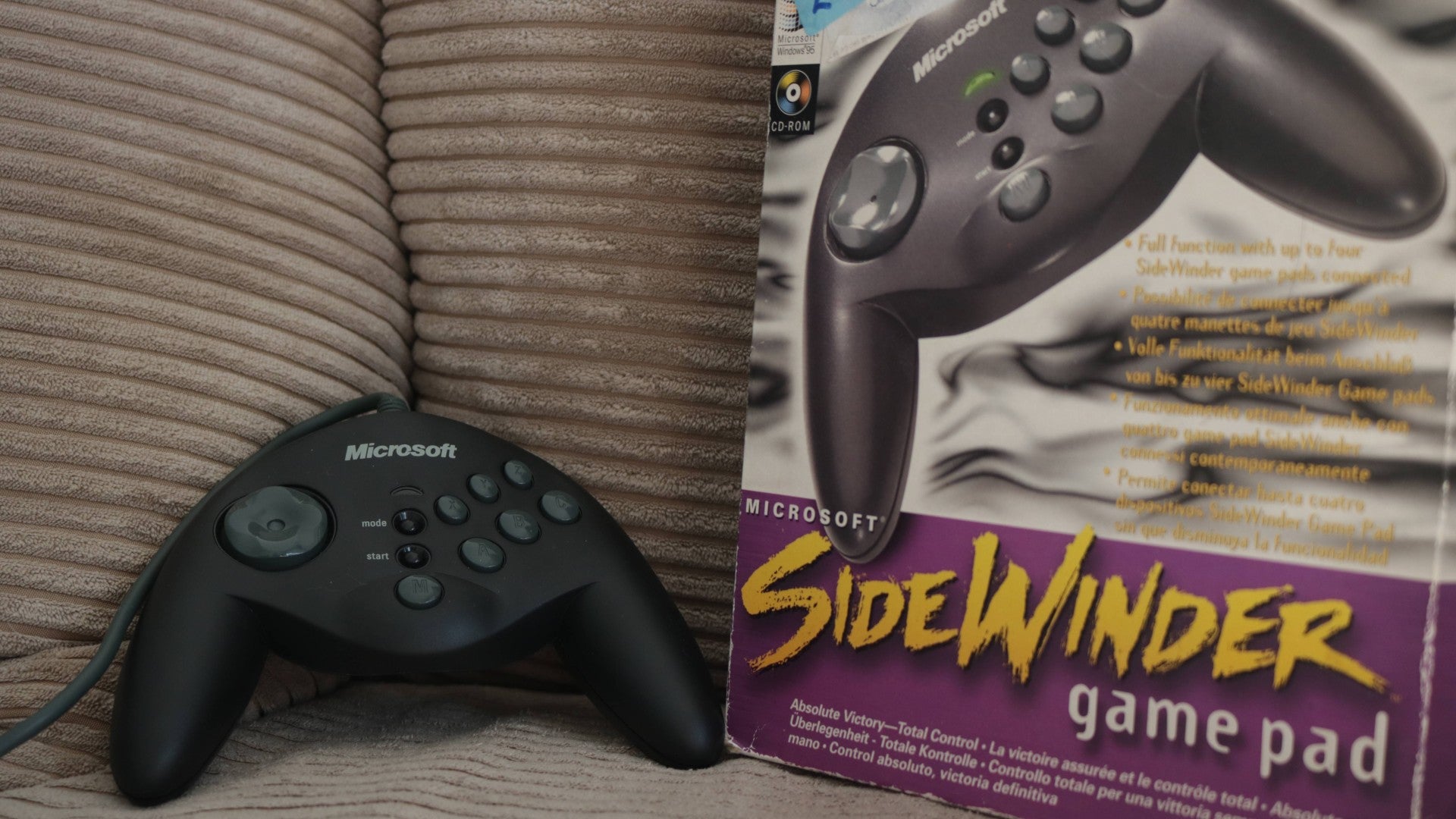
There’s no denying the power of old controllers to provoke fond memories in the handler, nor their continued popularity in the modern day – as evident in Nintendo’s production of imitation Gamecube and NES pads for the Switch 2. With growing preferences for emulation in the face of bankrupting retro game prices, many either go for custom controllers with modern functionality, or original peripherals connected via adapters, in order to preserve as much of the original experience as possible. But can the same be said for the SideWinder?
While I tracked down an old TV ad for the controller, my trawling of numerous old gaming magazines was less fruitful. I did come across a glowing review from the November 1996 issue of PC Zone by Dave Mathelson, praising the “two clever underneath buttons” (triggers were, indeed, a novelty at the time) and describing the handles as “horns” and the general design, more concerning, as “sexy”. The verdict was almost entirely positive, praising both the feel and the ability to create custom control schemes for each of your games. Yet, I feel this line perhaps betrays the controller’s struggles:
“While there are plenty of pads now available for the PC, the number of joysticks on the market didn’t stop Microsoft from releasing one…”
As much as I find the SideWinder interesting, I’d argue it’s more generic-looking than sexy. The late 90s/early 00s gave us attitude, explosions, and impractical designs you could only get by locking up a bunch of coked-up mandrills with CAD modelling software. An era ruled by the SpaceOrb 360 and the Fragmaster, the kind of creations birthed by an out-of-touch executive demanding kung-fu grip. Even Microsoft’s own SideWinder Strategic Commander, an early attempt at an RTS mouse, had that strangeness sauce.
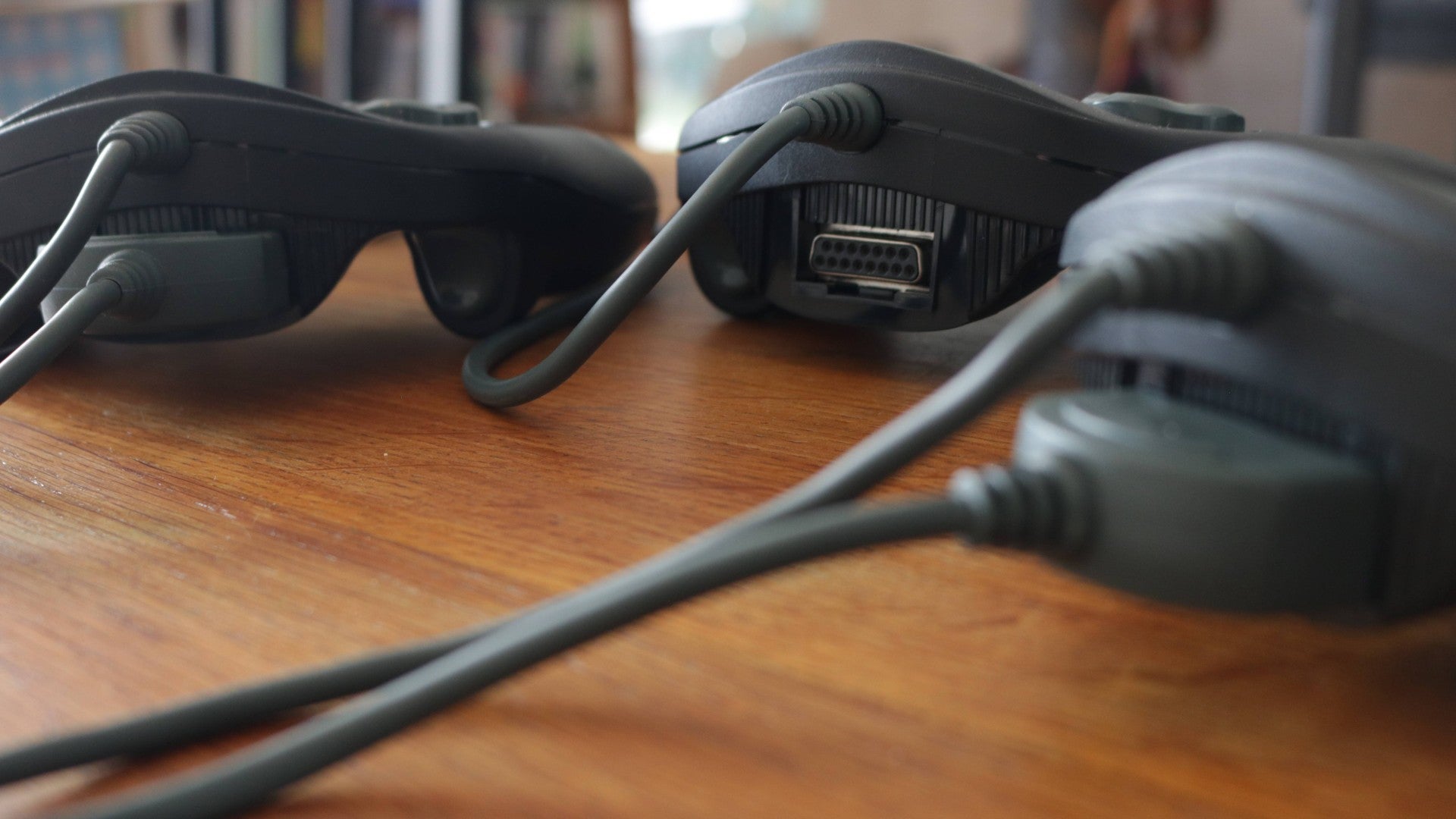
By comparison, the SideWinder Game Pad cuts a very subtle figure. There’s a seriousness to it. Still playful, as we are dealing with gaming. The nerd equivalent of dressing up in a new suit but leaving the top button undone. It feels like they were going for something more professional. The macro feature and the ability to customise your controller scheme for each game accentuate this point further, while also showcasing a design ethos Microsoft have long since abandoned: trusting consumers with the product you sold them.
Yet this also means it doesn’t stand out. I think Microsoft must have realised this at some point, as later additions to the SideWinder brand are more distinct, both visually and functionally. The Force Feedback Pro went on to sell over a million units, but the Game Pad hardly gets a mention in the news archives. For every Reddit post or TikTok short or LGR Review on weird and wonderful tech, the bland 1.0 is memory-holed even deeper.
Then, of course, there’s one other serious issue that keeps the SideWinder buried in the cable bin of yesterday: modern compatability.

As you can imagine, these things aren’t exactly easy to get working on a present-day PC.
My desktop, despite being a little dated itself, lacked the necessary connections to test the SideWinder. My motherboard still boasts old-school PS2 connectors for keyboard and mouse, but couldn’t spare a thought for more specialised retro gear. Granted, it’s not hard to see why. The controller (and a lot of the tech from the era) makes use of a 15-pin game port connector, appearing first on dedicated PCI cards, then later sound cards and eventually motherboards. These would eventually be phased out as USB became the go-to connector for personal computers, and while game port-to-USB adapters do exist, and even come bundled with later SideWinder products, procuring one today is surprisingly difficult.
So I went for the next best thing: a sound card from the 90s. A Creative Sound Blaster Live, torn from some ancient machine to grace me with the soft beauty of 16-bit audio and the game port’s connective tissue. I then quickly discovered that the card wasn’t compatible with my motherboard. Growing desperate as I battled both a looming deadline and my partner’s concern at the growing horde of retro tech, I managed to find someone selling two more SideWinders AND the game port-to-USB adapter. I snapped them up, plugged the adapter into my system, aaaaaand…
Nothing. The computer just couldn’t find it.

I’m saddened to admit I still attempted to get the blasted thing working long after this, eventually culminating in injuring myself while attempting to plant the sound card in an older machine. Taking this as a sign from the tech gods that I was not truly worthy of enjoying this artifact, I instead settled for a slightly newer (albeit still ancient) SideWinder Plug and Play. This came with USB out of the box, at the cost of fewer buttons and even less individuality, but I felt it would serve to at least give you some idea of how a SideWinder controller plays. Rest assured that if you think this damages the integrity of this retrospective, there is no one more ashamed than myself.

Prior to writing the article, I had a chat with my dad regarding the SideWinder Game Pad. He couldn’t stop gushing about it, saying how it was one of his favourite controllers back in the day. Unlike with Father Christmas, it appears my dad was telling the truth. The Plug and Play was genuinely fun to use, though perhaps not for the reasons my dad would expect.
I immediately fired up a multiplayer lobby of Titanfall 2, an FPS defined by its intricate movement systems, and proceeded to patiently stroll down the city streets, gaze locked forward. I could neither sprint nor turn the camera. In addition, incomplete control mapping also meant I couldn’t even shoot. I nearly fell out of my chair laughing as I was absolutely and immediately demolished.
I gave the original, 1993 Doom a whirl next, though again faced the issue of needing to dual wield with my PC mouse to rotate the camera for effective demon slaying. I ended up crab-walking into rooms, running back out, and letting the enemies funnel into my view. So somewhat more successful here.
Continuing my testing through retro and modern alike, I unleashed eco justice with Cloud in the original Final Fantasy VII, went bust in a round of Balatro, and tended to my farm in Stardew Valley. The SideWinder held up in all of them. I also gave some upcoming indie demos a whirl, successfully battling a demonic incursion in Entropy but tragically getting torn apart by bugs in The Last Exterminator.
Overall, so long as your game doesn’t require too many inputs (and also ideally takes place entirely within a straight hallway), the controller works great. My verdict? Ideal for Deep Space Corridor.

I’m sure that the SideWinder Game Pad 1.0 can be made to work with modern systems. Given enough time and a few more blows to my bank account, I could either fit my computer with the correct hardware, or hack together a game port adapter with an Arduino board.
I don’t intend to give up, but it’s also a pain point that’s going to be too much for a lot of people. Tech continues to hurtle forward, abandoning anything deemed inefficient for the world of tomorrow, with little care for ensuring compatabiltiy with the successes of yesterday. Sony already showed as much with their promise/threat to ditch physical games media. Do you think Microsoft are going to care about a controller that Asha Sharma has probably never heard of, much less used?
The truth of the matter is that, as foundational as the tech is, the SideWinder Game Pad was just an early casualty in an arms race that has slowly stripped uniqueness, choice, and especially this past year, affordability from players. Give it another decade, and if the tech overlords have their way, we’ll likely be renting our machines, streaming our games, and paying per hour for the privilege of using a controller.
Now, if you’ll excuse me, I’m going to enjoy my four SideWinders while I still can.


