
Many of today’s game designers have, like me, grown up with Japanese Y2K style – the style of the late 90s and early 2000s that gave us not only fear of the end of the world due to a calendar change, but also the WipEout series, futuristic PlayStation 2 ads, and fashion that incorporated everything from glitter to holographic fabrics and cute crop tops.
In a media landscape that seldom shies away from homages and sequels, I’ve waited a long time for the influence of childhood favourites such as Dance Dance Revolution and Space Channel 5 to pop back up. After all, plenty of Western developers have taken inspiration from Japanese role-playing games, giving us Sea of Stars, Undertale and Clair Obscur: Expedition 33, to name a few. Recently, I found some really cool games by Western developers that are living the Y2K dream with me, so it was time to dive into their inspirations and compare some childhood anime with some nerds.
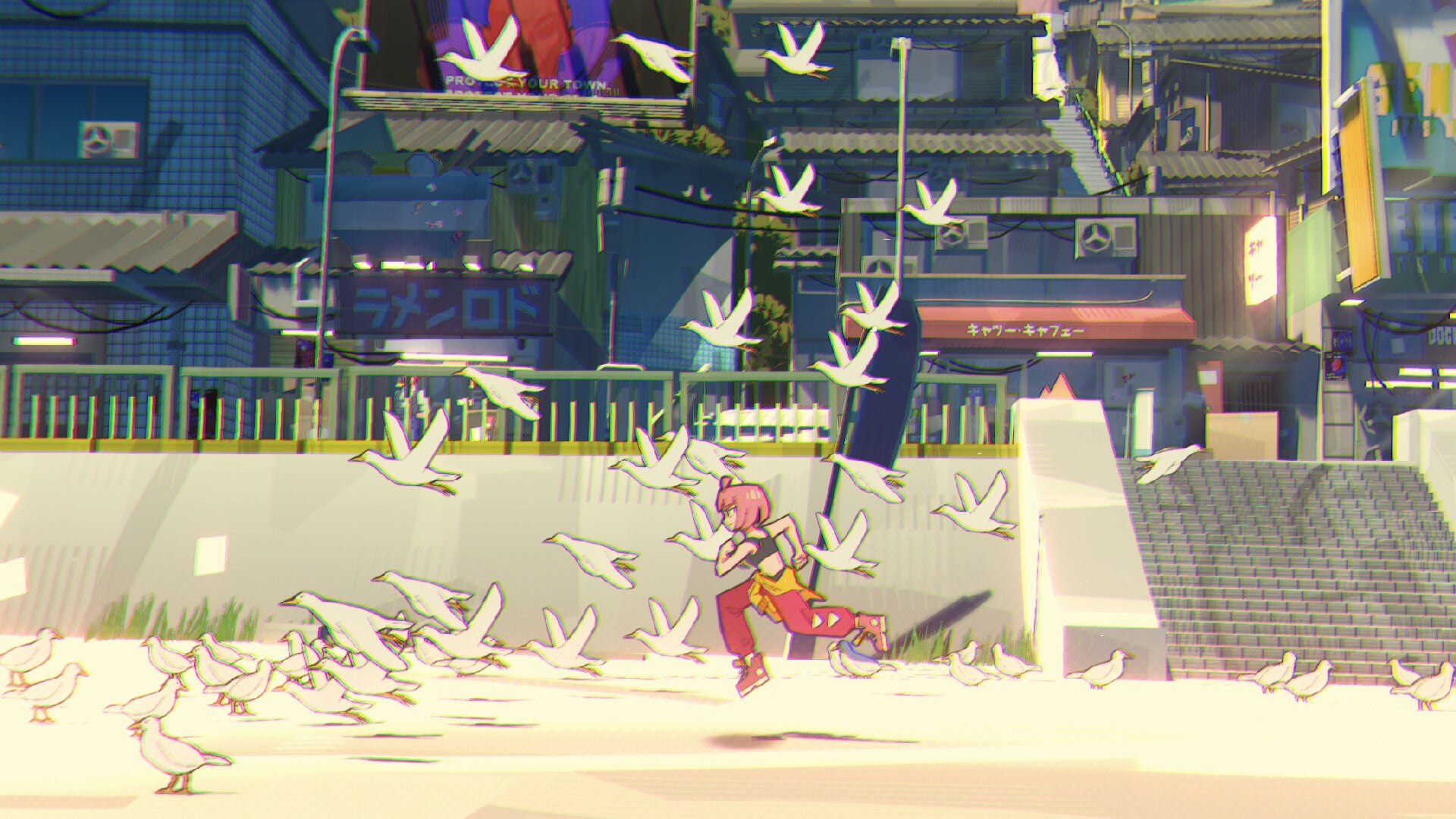
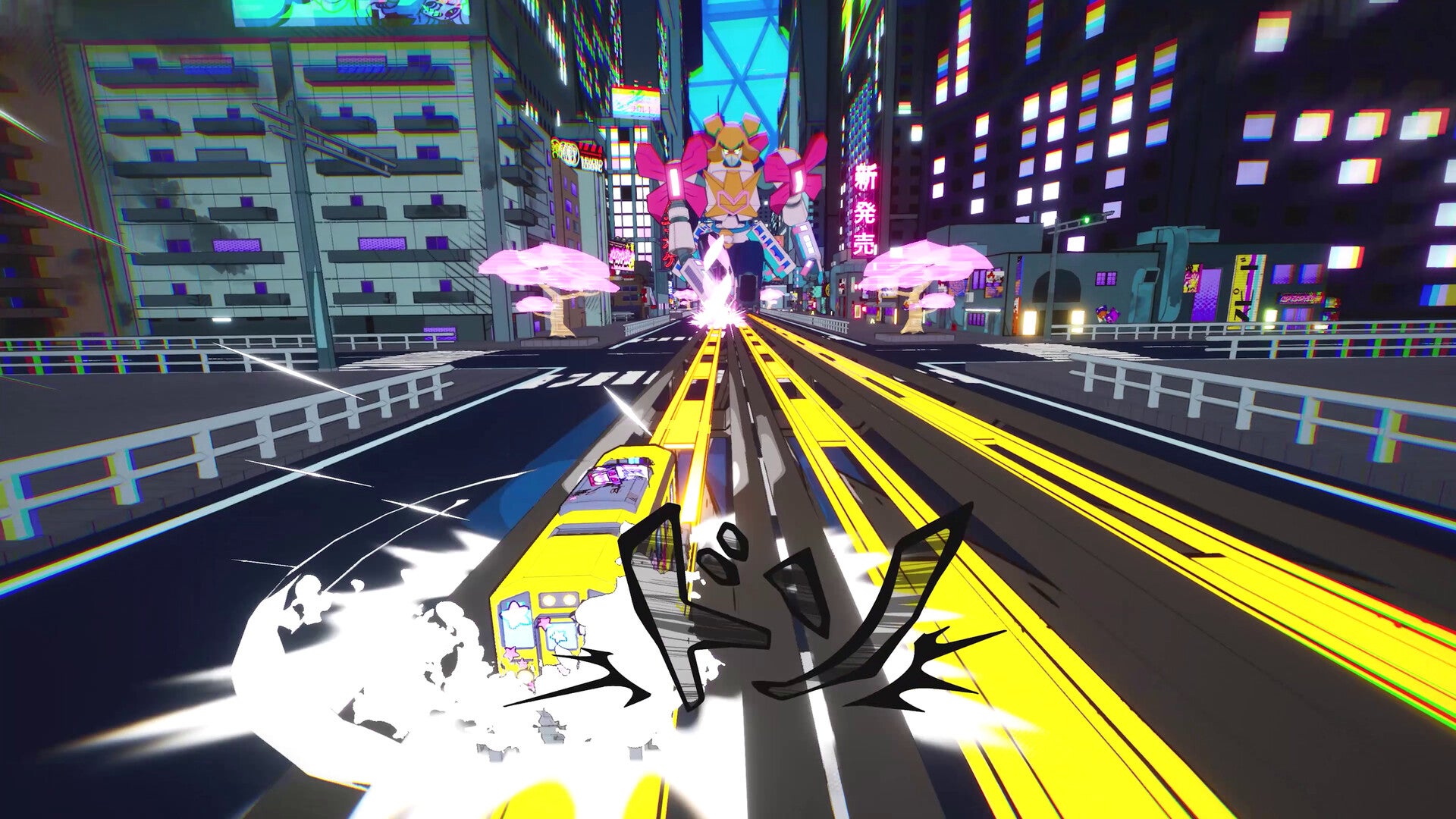
One such developer is David Jaumandreu, studio director at Undercoders, who are making Denshattack – a game that asks the brave question “what if Tony Hawk’s, but with trains?” From the name (densha is a Japanese word for a train) through the colourful Jet Set Radio-influenced style, bursting with speed lines and manga sound effects, to its tracks set near Japanese landmarks, Denshattack proudly wears its love for the country on its cab.
Watch on YouTube
Jaumandreu remembers the time anime became mainstream on Western television as pivotal to his development as an artist, with series such as Dragonball, Captain Tsubasa and Dr. Slump airing in his home in Catalonia, the UK and many parts of Europe for the first time in the 1990s. As regards video games, there was of course no way of avoiding Japanese games as soon as you chose to – gasp! – play on console.
This is no accident, as from 1980 onwards, Japan started to invest in a national branding strategy, first at home and then abroad. These efforts culminated in the coining of the term ‘Cool Japan’, inspired by the UK’s Cool Britannia marketing push in the mid-90s. I only remember these very early efforts at marketing Japan abroad as a recipient, but the Cool Japan strategy is still very much alive. As recently as 2024, the Japanese cabinet office outlined different initiatives that have already been funded, such as events, support for the localisation of different pieces of media including games and anime, and providing funding for Japanese companies to expand abroad.
It was during Jaumandreu’s first trips to Japan that he got to experience the country’s extremely efficient rail system and discovered the Densha de Go – “Let’s go by train” – arcade cabinet, a conducting sim with its own train driving peripherals.
Japanese trains are an important part of Cool Japan marketing – not many countries have a railway network that’s as wide and effective as Japan’s, and there’s undoubtedly something about the sleek lines of the Shinkansen highspeed train as it winds its way through the country. Train lines are so well-marketed in Japan that I wouldn’t be surprised to meet more developers who feel about them the way Jaumandrei does. There are themed calendars. There are anime mascots. The film adaptation of The Exit 8 led to several railway companies claiming to have found the station the game was based on – despite developer Kotake Create never revealing the station that inspired them – and offering Exit 8-themed AR experiences.
Anwar Noriega, CEO and co-founder of Mexican studio Wabisabi Design Inc, also traces his artistic development back to the original Cool Japan era. “Many of our happiest childhood memories are of coming home from school, turning on the TV, and watching anime like Captain Tsubasa, Saint Seiya, Dragon Ball, Sailor Moon, and many others,” he says.
Wabisabi are working on Hyperyuki (Hypersnow), a Y2K-inspired homage to extreme sports games like SSX Tricky. “For us in Latin America, creating a game like Hyperyuki is a love letter to all the joy and inspiration Japan gave us growing up,” Noriega goes on. “Anime are a major influence, specifically sports anime, where a single sport becomes the heart of the entire world. We wanted Hyperyuki to feel like a videogame adaptation of a 90s snowboarding anime that never actually existed.”
Watch on YouTube
My third interview partner is RJ Lake, director, writer, composer and jack of all trades at DCell Games. Their debut project is Unbeatable, which RPS reviewer Leigh Price hailed as “a raucous, scrappy rhythm game with a surprisingly heartfelt story to tell”. RJ wrote so lovingly on Digimon films in his response to my queries, that I genuinely hope someone else commissions him on the subject. But more importantly for us, he highlighted the importance of music to capturing the feeling behind Y2K art.
“Our game has some very obvious influences; there’s the nods to [now defunct anime studio] Gainax stuff, especially FLCL and how that anime incorporated [Japanese alt-rock band] The Pillows,” he says, “But Digimon The Movie, which is this lovingly strange bastard object grab-bagging three theatrical short films and stitching them together with a lot of music licensing, is legitimately a massive touchpoint for UNBEATABLE and how I think about how music and image can change contextually.”
Watch on YouTube
Of course music would be important to a rhythm game, but the significance and influence of Y2K music goes beyond rhythm games. A lot of Y2K fashion, for example, is the mainstream evolution of stuff you saw at raver parties in the 1990s. In a similar fashion, Y2K nabbed graffiti from New York hip hop culture, which had grown from a black subculture to a large, commercially successful genre of music. You can see the hip hop influence in the Jet Set Radio logo, for example. Sony had a graffiti ad campaign for the PSP that famously backfired with the culture. Parappa the Rapper, the game that’s widely cited as the first rhythm game, lovingly taps into the popularity of hip hop at the time, as do Tony Hawk’s and SSX Tricky, two of the arcade-style sports games that inspired the gameplay of Hyperyuki.

However, neither Hyperyuki, Denshattack nor Unbeatable take cues directly from hip hop. Instead, their developers point to another big name of Y2K rhythm gaming: Dance Dance Revolution.
For me, DDR always stands out as one of the things coverage of Cool Japan would point to in order to illustrate how ‘weird’ and kooky Japan was. Footage from Japanese arcades often showed young men fighting for their lives on a dance pad, doing something that only very generously could be called dancing.

While the idea of having the Rockband peripherals sounded cool and gave you social currency on the schoolyard, Dance Dance Revolution was for nerds. But DDR popularised the genre of rhythm games that you play using peripherals – Red Octane, the company that worked on Guitar Hero together with Harmonix, and which was recently revived, got their start as the manufacturer of peripherals for rhythm games such as Konami’s Guitar Freaks, a direct genre successor to DDR. So it wouldn’t be out of place to say that without DDR, there would be no Guitar Hero, and while peripheral rhythm games based on licensed music have largely run their course, the style of DDR lives on.
“DDR’s sound choices had roots in a lot of new jack, rave, house, trance, and club music of the early 90s that was really popular among Japanese producers at the time,” says Lake. “It’s what filters into a lot of non-‘traditional’ (i.e. classically inspired) game soundtracks over there well into the early 00s; you get this on the Sonic CD soundtrack, Initial D Arcade Stage, the music in Ridge Racer, and so on.”
Hyperyuki, too, calls on Y2K electronic for its soundtrack. “The soundtrack leans heavily into late-90s electronic music—Drum & Bass, Jungle, Garage, Techno,“ says Noriega. “We’re incredibly happy to be collaborating with talented artists who share the same passion for that era. Many of them are influential figures in the underground electronic scene and have performed at major festivals such as [electronic music festival] Mutek.“
Even Denshattack seems slightly influenced by rhythm games, seeing as it’s a game about avoiding obstacles at the right time. Wait, does that make platformers secretly rhythm games, too?
“We’re fans of rhythm-based games and there’s definitely an influence of them in Denshattack, but not in the traditional “hit the notes” sense,” Jaumandreu says. “The first layer of the gameplay is basic driving and that has a very rhythmical feel: reading the terrain, avoiding obstacles, drifting and braking at the right moment. The intention is to put players into a kind of flow state and, on top of that, have a secondary layer of player expression by tricking.”
Going beyond Dance Dance Revolution, it’s important to discuss the impact of Japanese arcades at large in the Y2K context. These days, we often call games ‘arcade-style’ if they’re easy to pick up and put down, with some genres offering arcade modes for quicker bursts of play. But for much longer than in the West, arcades in Japan were a driver for certain game franchises and genres. In a culture where people don’t really visit each other at home and the size of apartments often doesn’t allow for desktop PCs, arcades were often the way people played their games, and even when consoles started taking over the market, there would still be games that simply didn’t feel the same when played at home.
Actual arcade-based games had to be colourful and loud enough to stand out inside a jet hangar, and they had to feel good enough to make you want to come back for more. Japanese arcades are a place that simply need games to be at their most exuberant – both fun alone or with friends, and different from everything else clamouring for your attention. You can see this spirit in the boldness and liveliness of the games discussed here, even though they were developed for living rooms and bedrooms.
If any game is associated with the Y2K style, it’s Jet Set Radio, Smilebit’s Tokyo skating sim for Dreamcast from 2000. (Side note: 2023’s Bomb Rush Cyberfunk has been called a spiritual successor to Jet Set Radio, but when I contacted them for this piece, Dutch developers Team Reptile said their influences lie closer to home.) It’s not often that a 25 year-old video game is still turning heads, and so I asked all three developers why they think that is.

“The race for photorealism in games has become less important,” Noriega says. “The technological leaps simply aren’t as dramatic as they once were, so players are connecting more with stylised, expressive art directions. Stylistic games tend to age far better. That combination makes this visual direction not only appealing, but timeless.
“We wanted to build a larger-than-life world where snowboarding is the centre of everything, almost an obsession. From that idea, we designed characters with big personalities and exaggerated features, echoing the playful, slightly irreverent spirit of late-90s games, where developers weren’t afraid to get weird or whimsical.”
Noriega and Jaumandreu both point out that instead of going the way of more realism both in graphics and gameplay, which the Dreamcast hardware would have allowed for, many games of the era were instead whimsical and stylised, proving that the idea of good graphics didn’t have to equal hyperrealism.

“I think Jet Set Radio was one of the first games that understood video games as a creative medium, where raw graphic power could be invested into creating a unique artistic identity rather than only emulating reality with precision,” Jaumandreu says. “For quite some time, triple A games were the driving force in the post Dreamcast era and realism was favored as a standard style and moving away from that was seen as a risky option. I guess that with the emergence of indie games and the democratization of game development, we’ve come to a point in which creators can make bolder choices in their artistic direction and there’s a sector of gamers that appreciate it.”
Lake also mentions the power of nostalgia on both a visual and a textual level, which brings me to the thematic similarities all of these games share with Jet Set Radio and its like. There’s a certain emphasis on freedom here, and not just visually: all three games talk about being different, exuberant, about taking on the establishment. To me, there’s a counterculture element to the resurgence of Y2K in games and in pop culture that feels timely, as people lose faith in institutions and artists see the art theft machine automate their work away.
“Games of that era had this mix of anti-establishment attitude and playful absurdity that felt liberating, celebrating self-expression, colour, rebellion, and style,” Jaumandreu says. “I guess it works because it’s all about breaking the norm, right? People fighting against control naturally stand out from the crowd and break expectations. We think audiences are craving that again – something optimistic, expressive, and stylish in a world where many games lean darker or more realistic. That mix of resistance and wackiness is strangely timeless.”
Lake echoes these thoughts, but qualifies that looking back can be counterproductive. “It was important to me that in pursuing the aesthetic choices we were making we weren’t doing so flippantly or just as a veneer, so it’s a bit about a missed feeling, but in a very specific way,” he says. “Unbeatable is kind of about nostalgia on a textural level, too, and even the ways that yearning for what came before can be a double-edged sword.”

Much as they are dedicated to a particular time, I’m not sure you could accuse any of the above games of being captivated by nostalgia. All clearly show that even when you take an established formula, there are still always new things you can do with it, or facets to highlight. Hyperyuki is bringing Y2K to extreme sports games, resulting in a completely new feel for the genre. Unbeatable combines a narrative adventure with a rhythm game that is meant for both newcomers and genre aficionados, and Denshattack shows off Japanese trains in a way you’ve never seen them before.
There’s a lot of talk in games about repeating winning formulas to get the next Clair Obscur or similar, but talking to these developers, I think the games that took from what came before aren’t doing that out of calculated desire to produce a hit, but out of genuine love for an era and a commitment to its lingering imaginative possibilities.


