
As we sink ever deeper into a squelching mire of memory shortages, price gouging, and abandonment in favour of AI fantasy farms, there is one word above all that game-playing PC owners should keep front and centre in our doomscroll-addled brains: “relatively.”
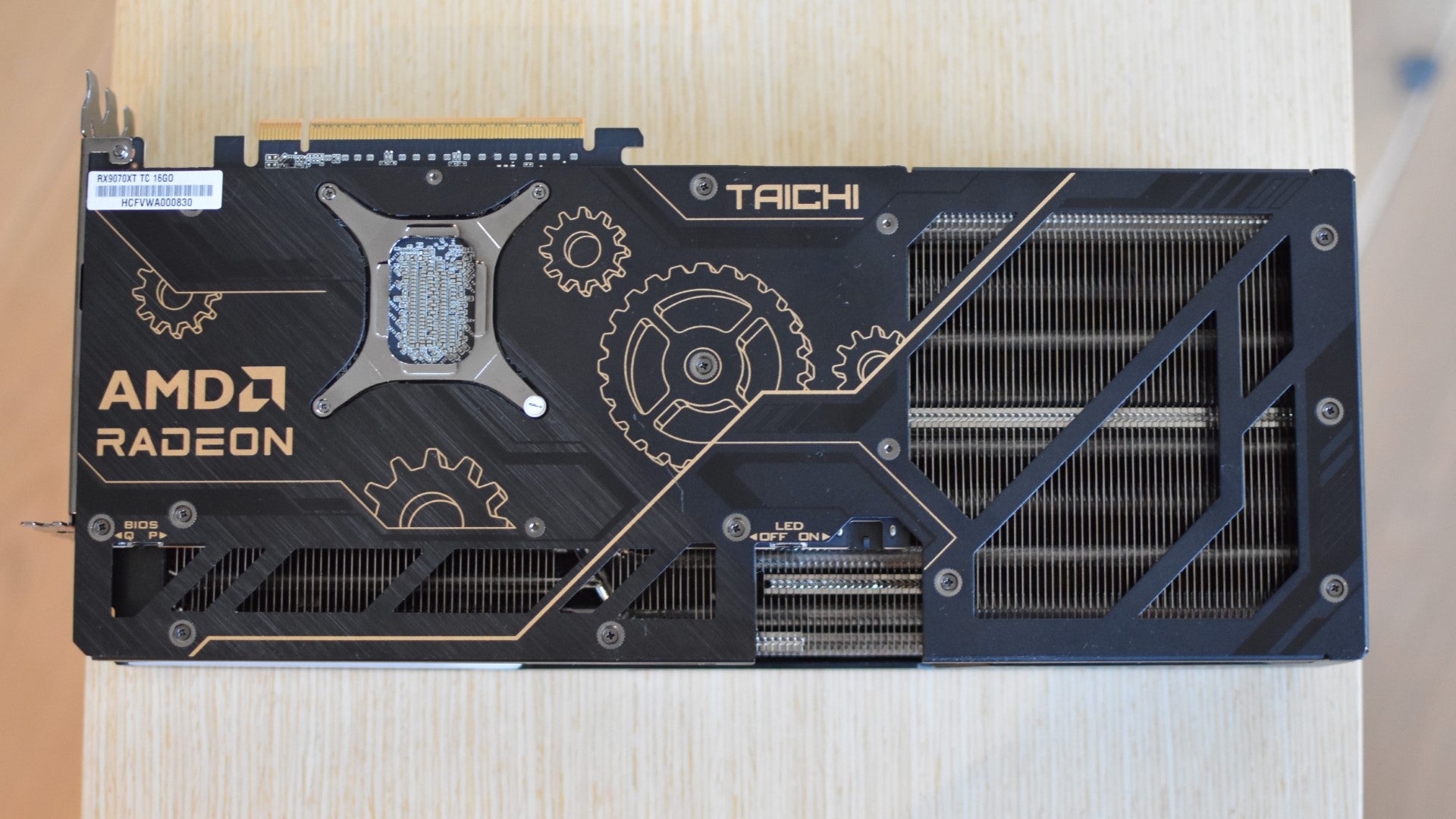
Take the AMD Radeon RX 9070 XT. It’s expensive, a launch RRP of £569 / $599 long since forgotten so entry-partner models can sit at £600 or – Yanks, look away – $720. Its current combination of upscaling and frame generation technology, FSR Redstone, is good but not quite as good as Nvidia’s new DLSS 4.5. And, as helpfully illustrated by the ASRock RX 9070 XT Taichi OC version I’ve been testing, a lot of these partner versions are quite spectacularly ugly.
Look at what it’s up against, though, particularly in the 16GB, fast 1440p/budget 4K bracket. I liked the GeForce RTX 5070 Ti at launch, but it’s felt the brunt of industry folly as painfully as any other graphics card: the cheapest ones have jumped from $749 in February 2025 to $900 in January 2026, and that’s only if you’re lucky enough to find one in stock. Availability is so bad at the moment that when a rumour recently spread that production was prematurely ending – quickly denied by both Asus and Nvidia themselves – thousands believed it was true, if just because, well, who’d even know the difference?
Now, the RX 9070 XT. It’s cheaper than the RTX 5070 Ti. It performs about as well, sometimes even better than the RX 5070 Ti. And, if nothing else, it’s still far easier than the RTX 5070 Ti to find in stock. Relatively, it’s a good choice. Which means we should probably have something at least resembling a review of it.
AMD Radeon RX 9070 XT: 4K benchmarks
With those same shortage/pricing issues tarnishing the RTX 5080’s appeal, and the RTX 5090 being out of reach for most mortals regardless, GPUs of the RX 9070 XT’s calibre have become much more attractive 4K engines. These benchmarks from the RPS Test Rig show why: it’s pretty much even with the RTX 5070 Ti in most games, and comes awfully close to the RTX 5080 in the demanding likes of Horizon Forbidden West and Assassin’s Creed Mirage.

At this rez, it can’t quite handle the ultra-luxury of path tracing: Alan Wake II, running at Ultra settings with full PT and FSR upscaling on Quality mode, only averaged 22fps. The equivalent settings in Cyberpunk 2077, plus FSR frame generation enabled, produced 46fps – but that just meant that its ‘real’, rendered frame count came in well under 30fps. The RTX 5070 Ti, by contrast, managed 33fps just with Quality-level DLSS and no frame gen at all, suggesting that Radeon GPUs still take a bigger hit from advanced lighting/shadow systems. Whack on the GeForce’s 4x Multi Frame Generation (MFG) mode, and that 33fps becomes 117fps.
That said, frame generation has never been as compelling a feature as Nvidia want it to be. Given MFG noticeably worsens input lag when multiplying lower rendered framerates, you’d get a smoother-feeling game by just lowering settings. At which point, the RTX 5070 Ti’s advantage disappears. It can still produce marginally faster results at upscaled 4K than the RX 9070 XT, like how Quality DLSS got it 104fps in HFW versus the Radeon’s 98fps with Quality FSR. But even with DLSS’s image quality benefits, which narrowed to a sliver with the launch of FSR Redstone, I’d rather keep the extra £160 / $180 in my pocket and enjoy what is, visually, an indistinguishable level of performance.
AMD Radeon RX 9070 XT: 1440p benchmarks
Our 1440p graph is almost a mirror image of the 4K results: very little in it between the RX 9070 XT and RTX 5070 Ti, with the exception of Shadow of the Tomb Raider, and multiple instances where you’d struggle to see the difference between the Radeon and the twice-as-pricey RTX 5080. Especially so, now that we’re getting into the 100fps+ region where small framerate variances aren’t as noticeable.

The cheaper RTX 5070 does come into the conversation here, and it remains a competent 1440p card. Still, if you can afford it, the RX 9070 XT’s conventional framerates go substantially higher, particularly in Total War: Warhammer III and F1 24, and arguably in HFW and Cyberpunk too.
Diminishing returns are still an issue at such high FPS, though here, it mainly makes that small performance win for DLSS upscaling feel even less significant. With DLSS Quality taking the RTX 5070 Ti up to 150fps in Horizon Forbidden West, and FSR Quality up to 143fps, the latter is easily better value for money – and on monitors with refresh rates capping at 144Hz, you couldn’t perceive the former’s extra 7fps, even if you had the eyesight of a fighter pilot with binoculars glued to their face.
Where the RTX 5070 Ti doesn’t need a photo finish is, again, ray and path tracing. Where 1440p provides more headroom to crank these settings up, Nvidia tech usually remains superior: adding Pyscho-level ray tracing to Cyberpunk, plus each GPU’s respective Quality-level upscalers, had the RX 9070 XT averaging 82fps and the RX 5070 Ti averaging 94fps. With path-traced effects on top of that, plus 2x frame generation, the RX 9070 XT did get a playable 93fps – but the RTX 5070 Ti rose to 111fps. The RTX 5070 Ti was also quicker in a path-traced Alan Wake II, scoring 55fps with Quality DLSS; the RX 9070 XT averaged 42fps.
Mind you, for garden-variety ray tracing, there are conditions where the RX 9070 XT can catch up. With Alan Wake II on Ultra-quality RT, one step down from path tracing, AND’s GPU averaged 73fps – only a single frame behind the RTX 5070 Ti’s 74fps on equivalent settings. Considering there was a time when every ray-traced game under the ray-traced sun would run its premium effects faster on GeForce hardware, that’s not a bad result at all.
AMD Radeon RX 9070 XT: 1080p benchmarks
1080p is normally where you see higher-end GPUs start to bunch up, as the CPU – even the beefy Ryzen 7 9800X3D in our rig – becomes more of a bottleneck. Even here, though, the RX 9070 XT is routinely clinging onto the RTX 5080, while comfortably outpacing the RTX 5070. To quite astounding effect, in Warhammer III:

Not that I’d suggest, inflation or otherwise, dumping this much money on a 1080p system. But this does make it three for three on resolutions where, between the choice of this graphics card or the more expensive RTX 5070 Ti, there’s little convincing reason to make the bigger investment.
In previous reviews, this would have been the point where I say “…except DLSS,” before launching into a whinge about how FSR just doesn’t look as good. Honestly, had I been timely enough to appraise the RX 9070 XT when it originally released, that’s exactly what you’d be reading. But times have changed, and not just in money and stock terms. FSR Redstone really can pass for DLSS 4 these days, and while DLSS 4.5 has just made further improvements to image sharpness and motion handling, they’re not really worth a nearly £200 / $200 levy.
Times can change so fast, in fact, that I won’t guarantee this verdict will still be applicable in a few months’ time. Maybe supply of Radeon cards will dry up as well. Maybe AMD will start charging more for it, just because they can. Maybe DRAM-addicted tech executives will go around owners’ houses at night, stealing their GPUs and sucking out all the memory chips like sports-jacketed vampires. For now, though, the RX 9070 XT is the high-grade graphics card to go for. Relatively speaking.


