
Capcom marks Resident Evil’s 30th anniversary with a stellar return that’s both a masterful bit of suffocating horror and a nostalgic, fan-thrilling victory lap for the legendary series.
Here’s a question: what is Resident Evil? For some, weaned on the series’ earliest entries, it’s campy survival horror – staccato gunplay punctuating smothering scares; for others, who joined the series with Resident Evil 4 and beyond, it’s perhaps closer to action. And there’s still a third group, who, since Resident Evil 7 redefined the series yet again, might be expecting something like horror in its purest form. 30 years on, Resident Evil is a series with so many identities, so many histories, that trying to resolve them all is a problem Capcom has struggled with time and again. But with Resident Evil Requiem, it feels like it’s finally found a way to address that tension: don’t fight it, embrace it all.
You probably already know Resident Evil Requiem is, in essence, a game of two halves. On one side there’s FBI agent Grace Ashcroft, who continues the modern series’ focus on heightened first-person horror. On the other is Resident Evil icon Leon S. Kennedy, who turns up intermittently to punctuate the tension with ludicrous, larger-than-life action. It sounds like a Resident Evil 6-style recipe for discordant disaster on paper, but in practice it’s anything but, even if the balance shifts dramatically as Requiem eventually goes places – both figuratively and literally – you might not be expecting.
No matter where it heads, though, Requiem is consistently spectacular. This is pure, mega-budget blockbuster gaming: gorgeous, meticulously realised, and polished to a sheen. Its prologue alone, hitting a tone that feels as much TV police procedural as Resident Evil, jumps from bustling, rain-drenched city streets – exquisitely rendered in first-person – to an abandoned hotel which, as Grace confronts her traumatic past, is host to playable flashbacks and campy funhouse chills. Then Leon makes his absurd, hatchet-twirling debut amid pile-ups and fleeing crowds, and on it goes – Capcom’s enormously talented team of designers, engineers, artists, animators, sound specialists, performers constantly exceeding Requiem’s incredible demands.
When Requiem eventually settles down, though, it’s for a sustained bout of pure horror that’s arguably the most terrifying the series has ever been – I might even go as far as to call Requiem one of the best horror games ever made. After Grace is deposited into the Rhodes Hill Chronic Care Center, where you’ll spend a significant portion of your playtime – perhaps the closest thing the series has come to a classic gothic “mansion” in a long while – you’re given a few minutes breathing room before your first major adversary arrives. And you’ll want to make the most of that lull, because once it gets going Requiem is relentless. Capcom’s control of atmosphere and tension, its command of pace, is impeccable, and the set-up for its first big reveal is a great example: an ominous rhyme in a children’s nursery book sows seeds of uncertainty and mounting dread, eventually culminating – after a tightly choreographed succession of jump scares and fake-outs – with a humongous claw sliding terrifyingly into view. And that’s just the start.
The creature, one of Rhodes Hill’s most persistent foes, is a wonderful bit of design, legitimately terrifying in scale but – with her forlorn gait, her tattered gown – oddly sympathetic too as she begins her relentless prowl. And it’s surprising just how far Requiem goes to humanise its monsters. One abomination you’ll encounter is so large it’s forced to squeeze itself – pitifully, painfully – along the mansion’s too-small corridors to continue its patrol. And virtually every zombie in Rhodes Hill is stuck in a loop of half-remembered living; undead cleaners attack filthy bathrooms with violent vigour, orderlies obsessively flick light switches on and off, cooks give chase with sharpened utensils, and you’ll even find a zombie by a grand piano belting out a tune. It’s at once a little sad and a little silly, and there’s an appealingly goofy throughline to Requiem that serves as critical connective tissue between the horrors Grace faces and Leon’s more outlandish trials. But crucially, once a zombie gives chase, the mood immediately chills.
For the bulk of Rhodes Hill, Requiem is skewed toward stealth. Often, Grace – as she sets off in search of yet another distantly scattered McGuffin – is corralled into cruelly claustrophobic spaces with minimal loops for avoidance, forcing a stressful rhythm of creeping progress and frenzied escape. Almost every zombie in Requiem is on perpetual patrol and, once alerted to your presence, they’ll happily, aggressively pursue you as far as their bounds will allow. Few have the brute-force strength of Rhodes Hill’s biggest adversary, admittedly, but even once Grace is armed, and even as her abilities grow, Capcom contrives – whether through limited ammo, zombies’ attraction to noise, or other rather more nefarious means – to ensure their threat is significant enough that stealth always feels like the better option.
And from that baseline of sustained tension, Capcom continues twisting the knife. Upgrades often require you to collect blood from zombies that might, you suspect, spring back to life at any moment; your inventory is small, meaning you always need to think carefully about what you carry and what you leave behind in safe rooms – miscalculate and you might need to backtrack, prolonging the ordeal. And if you choose to play on Classic mode, your limited typewriter ribbons mean limited saves. It becomes a game of tough decisions under pressure, Capcom constantly toying with the rules and the rhythm in a way that’s as exhilarating as it is exhausting. And there’s just so much else to applaud – the magnificent sound design, tiny touches like the way Grace’s hands shake when she holds her gun – all coming together to create this relentlessly oppressive mood. So it’s within this smothering blanket of stress that Leon’s segments – unfolding in classic third-person – are a welcome reprieve.

Leon’s series-spanning journey from fresh-faced twink to world-weary muscle daddy sees him, here, recast as something like the ultimate action hero – pure, wisecracking testosterone in a skin-tight shirt. From the very first moment you hit the ‘melee’ prompt and watch him roundhouse kick a zombie across the street, to the point he’s motorcycling up the side of a skyscraper or casually batting torpedoes out of the air, it’s clear Capcom isn’t so much embracing Resident Evil’s action heritage as revelling in it, with hatchet-wielding, viciously decapitating aplomb. And the balance feels right, Leon and Grace’s two distinct styles complementing rather than undermining one another.
But then, at almost exactly the midway point of its 20-hour or so runtime, there comes such a radical shift in tone that Requiem might as well be a different game entirely. Once you leave Rhodes Hill and you’re deposited in the beige dereliction of something like an urban war zone (I shall say no more on this), it’s Leon who – for a while at least – gets the bulk of the screentime, Requiem settling into a new rhythm that overwhelmingly favours intense action. Even as Grace begins to play a more prominent role again later on, her usual stealth is – bar one brilliantly creepy late-game surprise – given a far more urgent pace. It’s not that this mid-game shift is especially unusual for the series, but after such a masterful first half, the change – and the sudden dissipation of Capcom’s meticulously cultivated atmosphere – is incredibly jarring. Disappointing even, and it takes a bit of mental recalibration before it can be properly enjoyed.
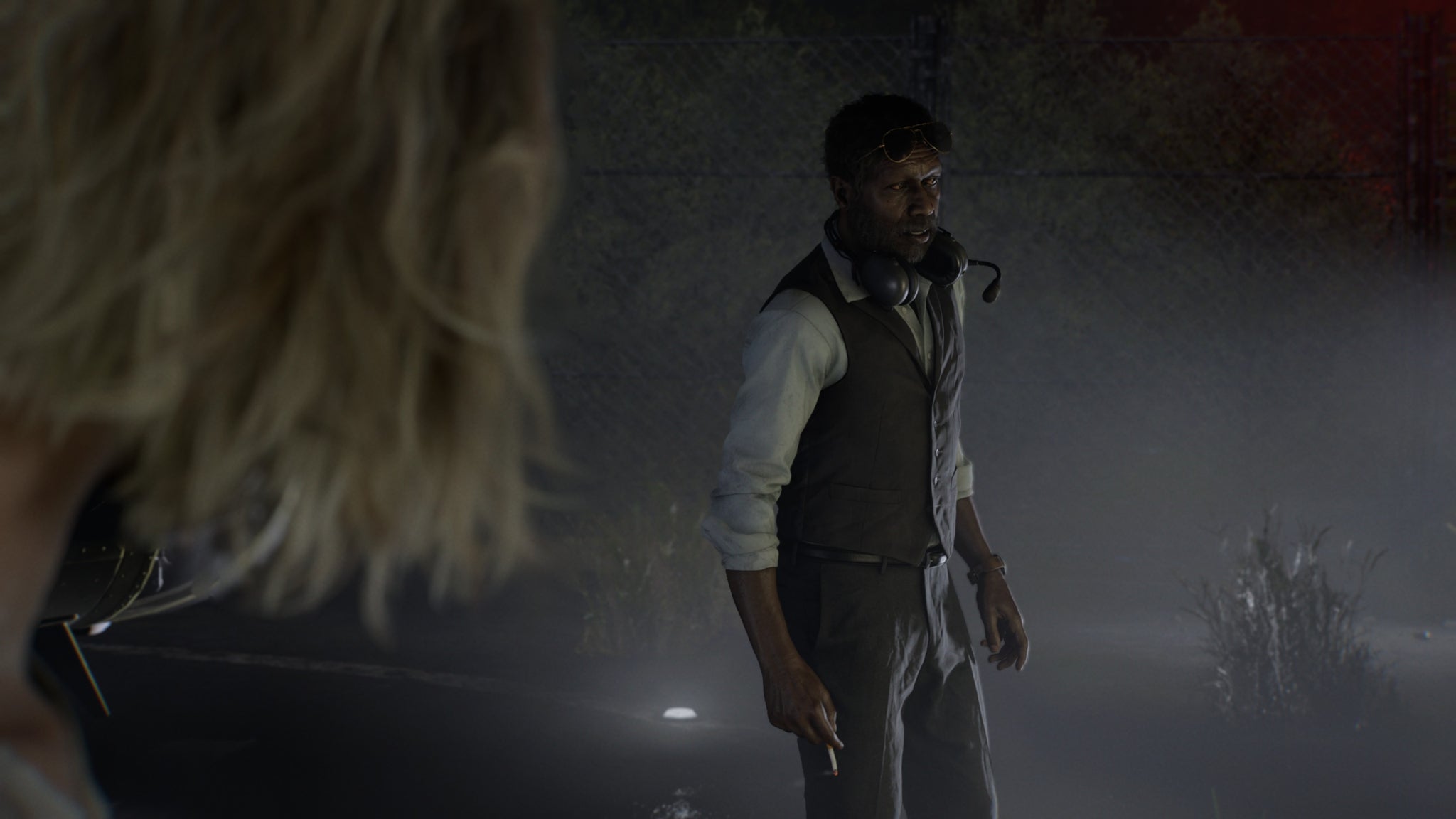
But it is, still, enjoyable. The gunplay remains great in its slickly ridiculous action-movie fervour, Leon’s arsenal growing to absurd proportions as he hoovers up machine guns, pistols, grenades, sniper rifles, and anything else capable of obliterating the undead as noisily as possible. Even the inventory system shifts to something more conducive to this pacier rhythm – forcing you to Tetris your spoils into the equivalent of a Resident Evil 4-style attache case until space is gone and decisions must be made. And as you race across rooftops dodging mortar fire, or take on the heavily armoured undead in increasing numbers, its action – its constant ambushes and fights-in-tight spaces – remains tense and exhilarating, albeit in entirely different ways. If anything, with Rhodes Hill behind it, Requiem adopts a more transparently old-school vibe – and, if you hadn’t already twigged, this isn’t accidental.
The clues are there from the start of course – it’s right there in the name! – but Requiem isn’t just a horror game; it isn’t just an action game; it’s a joyful, honest-to-goodness celebration of Resident Evil, this legendary series, as it enters its 30th anniversary year. And the longer it goes on – the more it borrows and repurposes from the past – the more it plays like a gift to fans. It’s there in that sprawling mansion that feels like a return to the start; in its shifting camera perspectives and shifting tones. It’s there in its different inventory systems from two different eras, in the typewriter ribbons, and the wonderfully old-school puzzle contrivances. It’s there in a bifurcated campaign that feels like a Resident Evil 6 callback, in an upgrade system for Leon that feels ripped right out of Mercenaries, and it’s there in so many other ways. I’m not going to say too much more – partly because Capcom understandably wants to keep Requiem’s biggest surprises secret, and partly because I wouldn’t want to spoil their impact anyway – but the more it played into its legacy, the bigger my smile became.
There’s a clear tension here in that the first half of Requiem is incredible; a straight-up horror classic as far as I’m concerned. In contrast, its latter half is less obviously remarkable; boundary pushing horror making way for a slightly retro, backward-looking celebration of the past. That makes it tricky, if not outright impossible to judge. Is Requiem uneven? Absolutely. Does it eventually, slightly, run out of steam? I think that’s a fair criticism too. But carried away on a wave of increasing nostalgia, I didn’t especially care. In a way, Capcom’s deliberate – and impressively cohesive – grab bag approach to Requiem almost makes it impervious to criticism, and you might as well just sit back and enjoy the ride. And with 30 years of brilliant, ludicrous nonsense squashed down into a single game, this well-earned victory lap is one hell of a time.
A copy of Resident Evil Requiem was provided for this review by Capcom.


