
Here, put on this pair of reflective sunglasses. Now regard the 21st century so far. Doesn’t it look as if the ideas of Deus Ex have spread into the mainstream? Like fire propagating across a dry hillside, the prevalence of emergent action with cascading consequences has spread throughout the gaming medium.
Much of this movement towards Ion Storm-style thinking may be coincidental. Were the Nintendo team behind The Legend of Zelda: Breath of the Wild making injokes about the Denton brothers on their lunch breaks? Did they praise Warren Spector as they imbued metal weapons with the capacity to attract lightning strikes? Perhaps not, and without slipping a bug under a Kyoto water cooler, we’ll likely never know.
But for some top designers, spreading the good word of Deus Ex has been utterly deliberate. One is Emil Pagliarulo, who long ago worked at Looking Glass on Thief II: The Metal Age. It’s he we have to thank for Life of the Party, the standout level in which Garrett scampers between rooftops and open windows, drawing an impromptu path between the private properties of priests, nobles and necromancers.
“I love the original Deus Ex. It’s a huge influence on me.”
Ever since, he’s been at Bethesda Game Studios – conceiving Oblivion’s Dark Brotherhood before becoming lead designer and writer of Fallout 3. The latter game became a playground for Pagliarulo’s long-nursed design philosophy. “As much immersive sim as was humanly possible, that I could bring in, was really what I wanted to do,” he tells Rock Paper Shotgun. “I love the original Deus Ex. It’s a huge influence on me.”
There are “scene-by-scene” memories of events in Deus Ex that have stayed with Pagliarulo to this day. “I remember breaking into a house that I thought was empty to find something, and the maid turned the corner,” he says. “I was like, ‘Argh!’. I didn’t want to kill her, so I took out my shock prod, and was in this panic, rushing to do stuff before she gained consciousness.”
NPCs in Deus Ex do not, in fact, wake up again after they’re knocked out. But I, too, remember the discombobulating thrill of being given power over life, death and unconsciousness in Deux Ex; the moral commentary of JC Denton’s peers at UNATCO, and the giddy sense of playing right at the nanoblade’s edge of what was possible in PC games. I can imagine I worried that the maid might wake up too.
It was moments like these that Pagliarulo really wanted to fold into the Bethesda formula. “We had done Oblivion, but I knew that we could take it even further in Fallout 3,” he says. “Trying to get the stealth better, that was only part of it. There were definitely other people that contributed to that as well.”

You might recall that Oblivion had a rather basic take on sneaking: either you were spotted, or you weren’t. It was Fallout 3 that introduced degrees of detection, allowing players to live in the tense twilight zone between getting away with it and a sudden, unwanted firefight. Noises attracted attention, as did movement. Forgetting to turn off the light on your Pip Boy might give away your position to a feral ghoul in a railway tunnel.
It was stealth that first alerted me to a kinship with Deus Ex when playing Fallout 3 in the Christmas of 2008. That, and the body tracker that warned you of crippled limbs, which turned momentary mistakes into meaningful injuries. (If you crippled an enemy’s head, by the way, their lowered Perception made them much easier to sneak by.) It’s these rolling consequences that anecdotes are made of.
“You see this with a lot of people who worked at Looking Glass, or Ion Storm Austin,” Pagliarulo says. “Those are folks who went on to work for Arkane on Dishonored, so that DNA has definitely spread throughout our organisation. But yeah, I really wanted to bring that to Fallout 3 as much as I could.”

Pagliarulo has spoken about the impact of Deus Ex on Bethesda’s reinvention of Fallout before. In fact, he mentioned it to some bloke named Kieron Gillen a decade and a half ago. “For me personally, no other game had as much influence on Fallout 3 than Deus Ex did,” he said at the time. “By far. I mean, huge inspiration to the point where I knew I was replicating… I mean, I knew I was stealing from it wholesale at some points. And happy to do so.”
When most people look at Fallout 3, they look at the legacy of this studio and don’t look beyond it…
Yet you almost never hear Deus Ex, or immersive sims in general, mentioned in connection with the ongoing Fallout series. I believe Pagliarulo identified why back in 2010. “If I say the games are the soul of Looking Glass… well, it’s also the soul of early Bethesda games. They’re very immersive first-person things. The Terminator: Future Shock, The Elder Scrolls: Arena or Daggerfall. So when most people look at Fallout 3, they look at the legacy of this studio and don’t look beyond it… and if they did, they’d find a lot of Deus Ex in Fallout 3.”
Perhaps that influence was disguised, too, by the fact that early Fallout had plenty of immersive sim thinking to it. If you could pick an NPC’s pocket, Black Isle reckoned you should be able to place an item in that pocket as well. And if that item happened to be a stick of dynamite on a timer, then that was all for the good. Fallout 3 replicated this sort of systemic problem-solving with planted grenades and mines. The reverse-pickpocket is known, in some quarters, as the Shady Sands Shuffle.
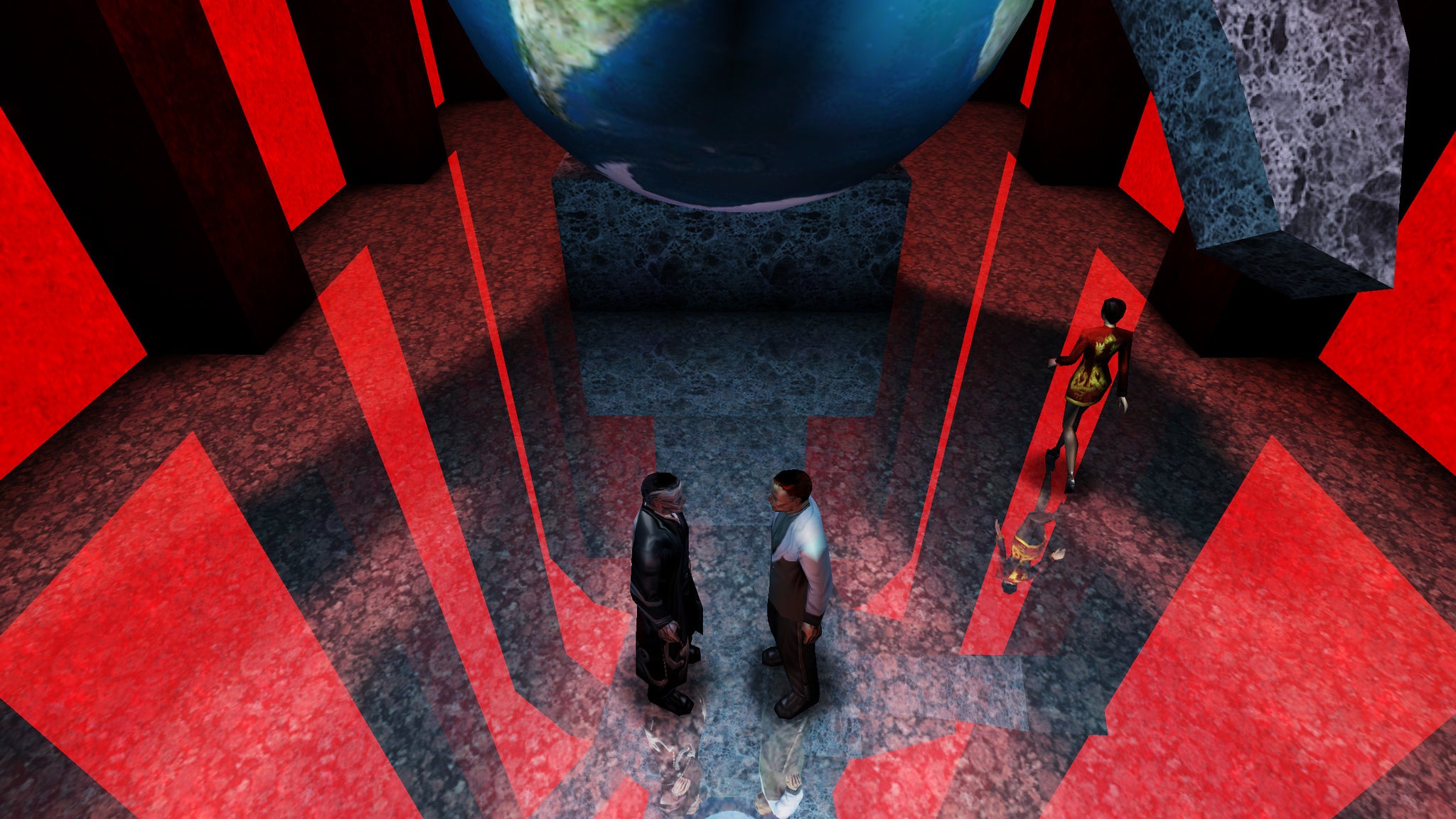
Pagliarulo acknowledges, however, that adapting Deus Ex design to open world RPGs isn’t necessarily straightforward. “You know, it’s always difficult, because in a game like Dishonored or Thief, you’re playing as a single character and the gameplay focus is really narrow,” he says.
In a game like Fallout 3, the lens is a lot wider. “We let you play as any type of character you want, and there are all these systems. And so, if you want to shoot your way through or sneak your way through, we have to support all of it,” Pagliarulo says. “Trying to do that… it was not like back in the day of Thief 1, where they put in the fire arrows because they wanted to appeal to Doom and Quake players who wanted a rocket launcher.”
Some may argue, justifiably, that Fallout: New Vegas better delivered on the freedom of approach that Pagliarulo was shooting for. In the quest to get inside a Mojave power plant, for instance, you’re presented with a tasting platter of doors to be unlocked, disguises to wear, NPCs to be duped in conversation or pickpocketed for their passwords.
But the groundwork for all of this was laid beforehand by Bethesda. Systemically and philosophically, Fallout 3 set up the series to be far more flexible and unpredictable than it might have been otherwise. And that’s in large part because one guy couldn’t get Deus Ex out of his head.


![Cronos The New Dawn [RUNE] + [Update v1.4.0.0] – MaxBit](https://i0.wp.com/gamepcfull.com/wp-content/uploads/2025/09/Free-download-cronos-the-new-dawn-gamepcfull.jpg?w=100&resize=100,100&ssl=1 "Cronos The New Dawn [RUNE] + [Update v1.4.0.0] – MaxBit")

