
I’ve spent the last 14 years surprised that more games haven’t stolen the central gimmick to 2012’s Fez. A 2D world that you can rotate like a 3D object to find hidden secrets is the kind of trick that never gets old. But the Fez-like era never really happened and I’ve been left to wonder what it might be like to play something even half as clever.
Cassette Boy is the closest I’ve ever got to playing a game that might actually rival Fez. While it lacks Tetris blocks and made-up languages, it’s full of similarly mysterious characters and puzzles to uncover as you spin every level around in search of answers.
The moon is gone and you, a small boy made of white cubes, are on a mission to find it. Cassette Boy begins as a legally distinct Zelda clone—you pull a sword out of a stone in the first five minutes—and transforms into something else the moment you have the power to turn the world around as many times as you’d like.
Once you make it past the intro, Cassette Boy opens way up. I’d enter a room with three exits and find myself going down long rabbit holes before ever returning to see where the other paths led. A long hallway with skeleton archers turned out to be its own puzzle as I spun it around and around trying to figure out how to access every adjacent room. Sometimes it was as straightforward as flipping the hallway 90 degrees to reveal a doorway, but other times it took climbing to the level above and dropping down to where I wanted to be.
Annoyingly, I discovered my one weakness with a game that requires you to hold an image of a level in your head: I am really bad at it. I’m already directionally challenged in games built like mazes, but Cassette Boy is even worse because you frequently enter familiar rooms in entirely different orientations than before. The positive effect of this is that you can catch secrets you’ve missed in rooms you’ve passed through several times already. But if you have trouble remembering where you came from and where to go, it’s a nightmare that I’m not sure the game is trying to impose on you. There were a few times in the couple of hours I played where I was starting to get bored running through rooms looking for where to go.
That is the bargain you make with a game as quiet as Cassette Boy. If it wasn’t so fun poking around its world and feeling smart for discovering things I wasn’t told about, I might’ve given up on it. But it kept surprising me and pulling me back in.
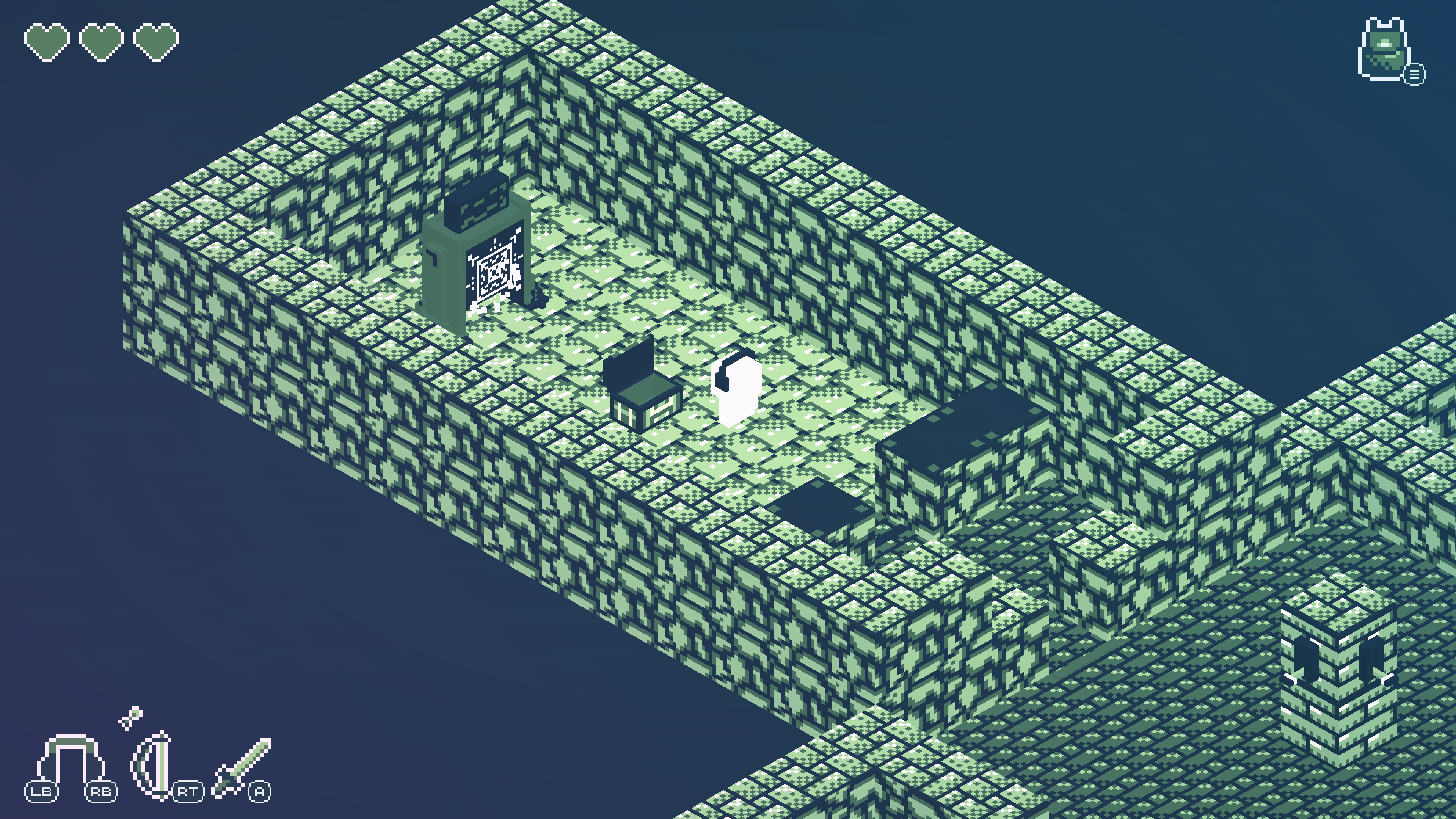
I was stuck on a puzzle for a solid 30 minutes where I had to stand on pressure plates and rotate the perspective to hide them behind the environment and lock them in place. (You’re told early on that anything you can’t see is frozen in place and rendered intangible, which sure gives me some theories about where the moon went!) The problem was that every time I spun the room around so I could activate the lever, one of them would become visible and reset, raising a wall blocking the lever. Then I had an idea: Is it possible to lower the wall, shoot an arrow toward where the lever will be, and quickly rotate the room so the wall raises behind the arrow as it flies toward the lever? The thrill I got when it worked brought me right back to 2012.
Cassette Boy is the Fez-like I’ve always wanted. In fact, calling it that feels like a disservice to everything else it’s doing that isn’t like Fez at all. I’ve seen footage of later areas in the game when you have access to bombs and other tools that expand the scope of the puzzles and how you approach each area. I would’ve been happy with far less, but it’s exciting to know the game only gets more dense with secrets as it goes along.
Cassette Boy is out now on Steam.


![Homura Hime [RUNE] – MaxBit](https://i3.wp.com/gamepcfull.com/wp-content/uploads/2026/03/Free-download-Homura-Hime-gamepcfull.jpg?w=100&resize=100,100&ssl=1 "Homura Hime [RUNE] – MaxBit")
