
Need to know
What is it? XCOM as a solar system-spanning grand strategy game
Release date January 5, 2026
Expect to pay $40
Developer Pavonis Interactive
Publisher Hooded Horse
Reviewed on Ryzen 7 3700X, RTX 4070 Super, 32 GB RAM
Steam Deck Verified
Link Official site
If you’ve played any of the XCOMs, the premise here will be familiar—appropriately enough, given that it comes from the people behind Enemy Unknown’s cult hit mod The Long War. Aliens are attacking present-day Earth and it’s up to you to figure out why they’re here, what they’re made of, and send them packing. Or maybe make friends. Or just profit from the chaos. We’ll get to that in a minute.
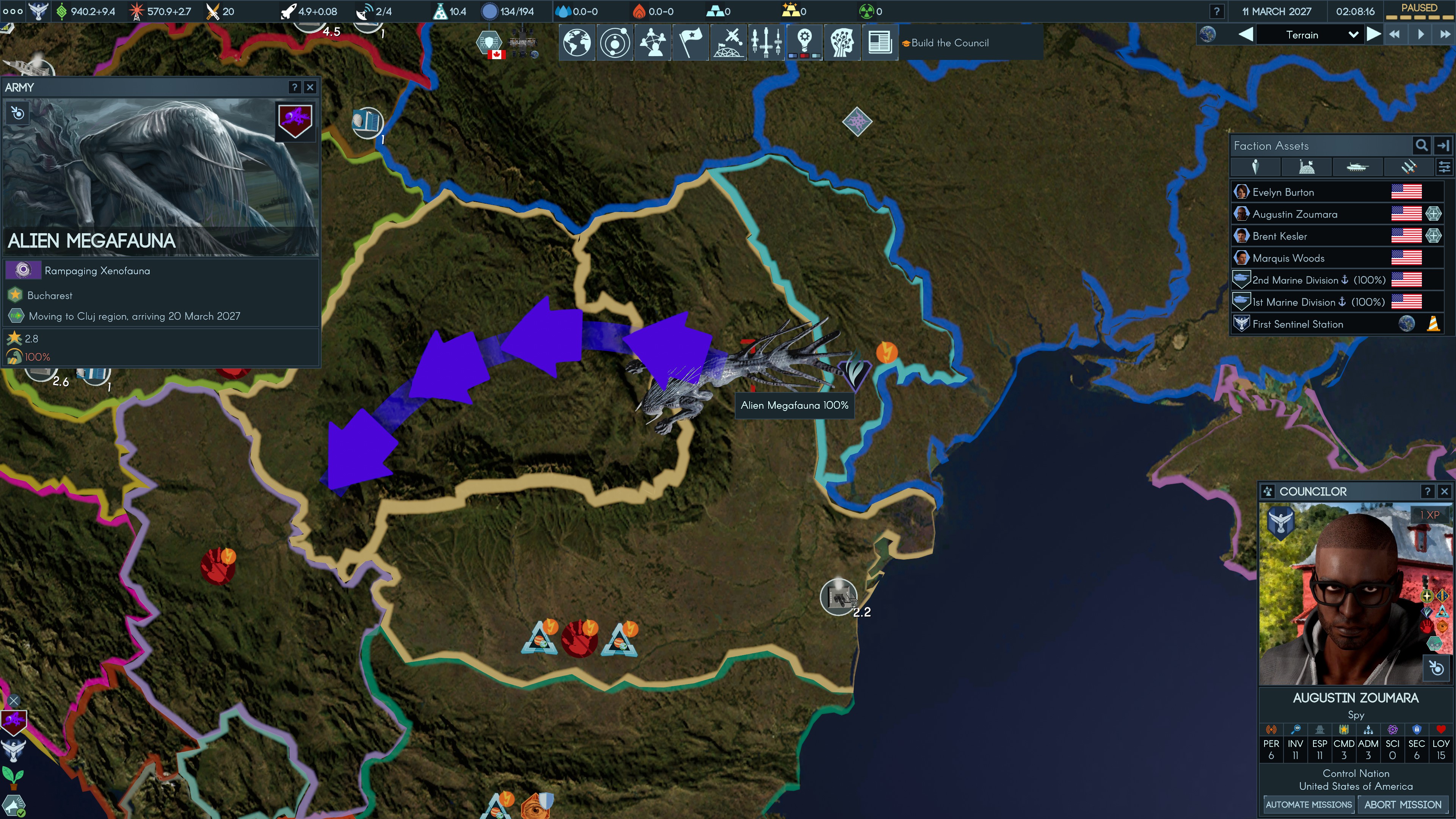
Down on Earth, you can click on a nation to see stats like environmental sustainability, wealth inequality, and education—all of which can shift over time through the influence of various pro-human and pro-alien factions. Even for a seasoned grand strategy player with thousands of hours in Europa Universalis, it’s a lot. The sheer amount of stuff being simulated creates an almost incomprehensibly rich board for the war against the aliens to play out on. And sometimes that works in its favor. Other times it can get in the way.
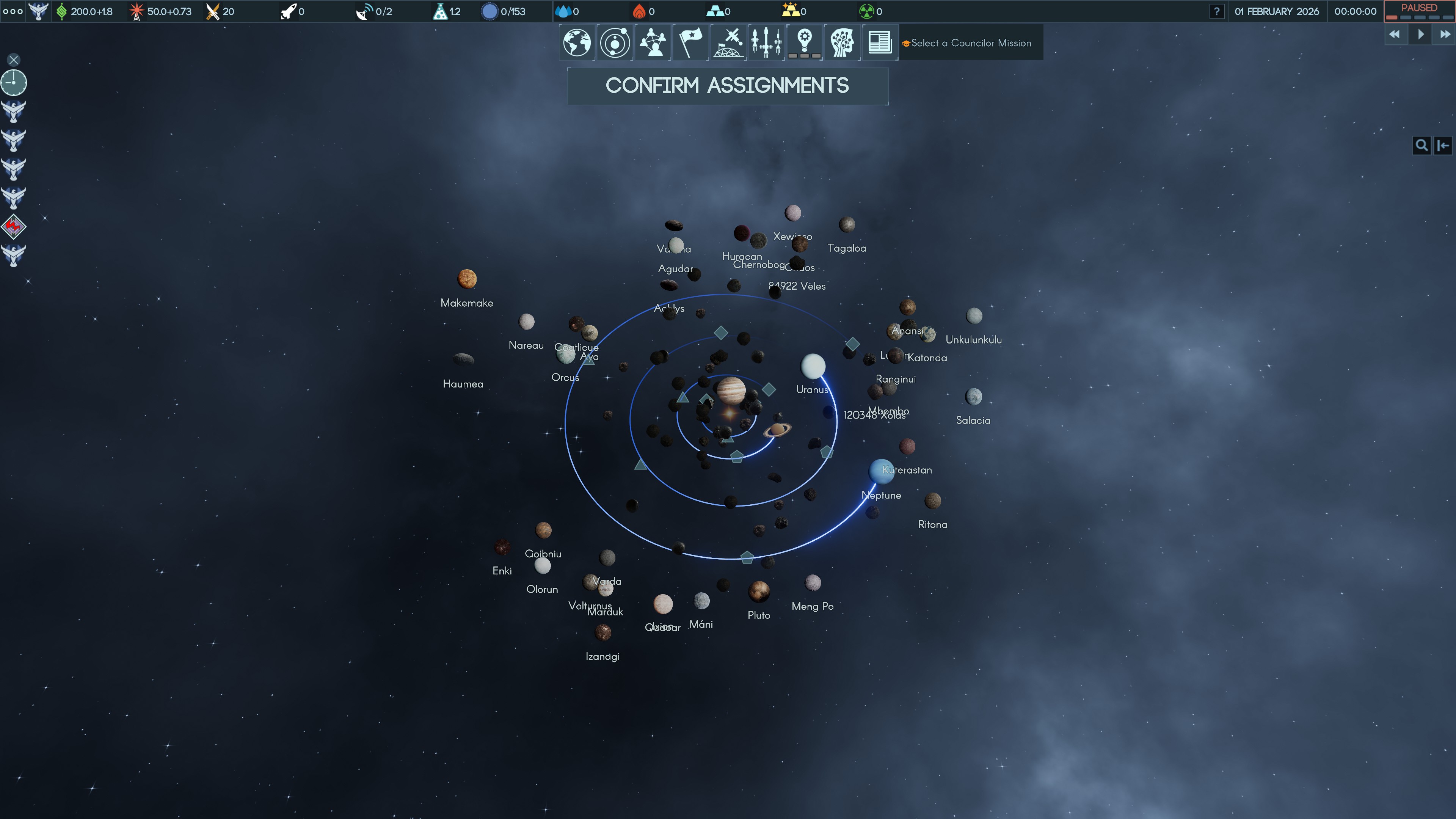
The main tools you have to interact with this sprawling corner of space are your councilors—recruitable agents with jobs like Astronaut and Tech Billionaire, personal traits like Addict and Elder Statesman, and different missions they can be deployed on like Investigate Alien Activity and Control Nation. You’re not playing as a country here, but rather one of several factions with a shared ideology. The Resistance is the most straightforward, simply wanting to fight the aliens and get them to leave. Project Exodus has decided that the better part of valor is assembling a generation ship and getting the hell out of here. The Servants are a religious cult that wants nothing more than to bow down to the aliens.
Why we fight
Through propaganda, bribes, and espionage, your faction can gain influence over the world’s various nations and nongovernmental organizations, allowing you to control their armies and space programs, dip into their funding, and even socially engineer them with environmental and welfare programs if you’re feeling a bit utopian. From the default start date of 2026, it was definitely cathartic to seize control of the deep state and Green New Deal the failing United States back into a functional republic like the conspiracy theorists are always claiming we want to.
The UI for all of this can be a little obtuse and disorganized. Especially with the amount of information you need to make optimal decisions, it’s a constant friction point, with some odd omissions like the inability to sort certain important columns in spreadsheets. Opening the tech tree may be enough to send the average gamer fleeing into the woods, never to touch a PC again. But it is at least functional, if not always intuitive, and quite a bit more readable than it was in the early access release.
This focus on competing ideologies over nations is a major strength, though. It’s reminiscent of Alpha Centauri, with voiced faction leaders who read out the hundreds of interesting tech quotes. And that’s an influence Terra Invicta definitely wears on its space suit sleeve. It also adds an element of replayability, since a faction like The Initiative has a completely different storyline and endgame from everyone else. But hold that thought: I don’t ultimately see many people signing up for a second round of this for other reasons.
The writing is sharp and interesting across the board, with a lot of those satisfying XCOM plot beats like doing your first alien autopsy or shooting down your first UFO. There’s a lot of background detail lovingly woven into the scenario, from the complex biology of the aliens to the suite of near future tech that can become available, reshaping the world in ways that go beyond just fighting back. Even when the war starts to drag, there’s climate change mitigation and transhumanism to mess around with, and it all has an impact at the systems level. Most of it has a pretty sound, hard sci-fi grounding for the science nerds in the room as well.
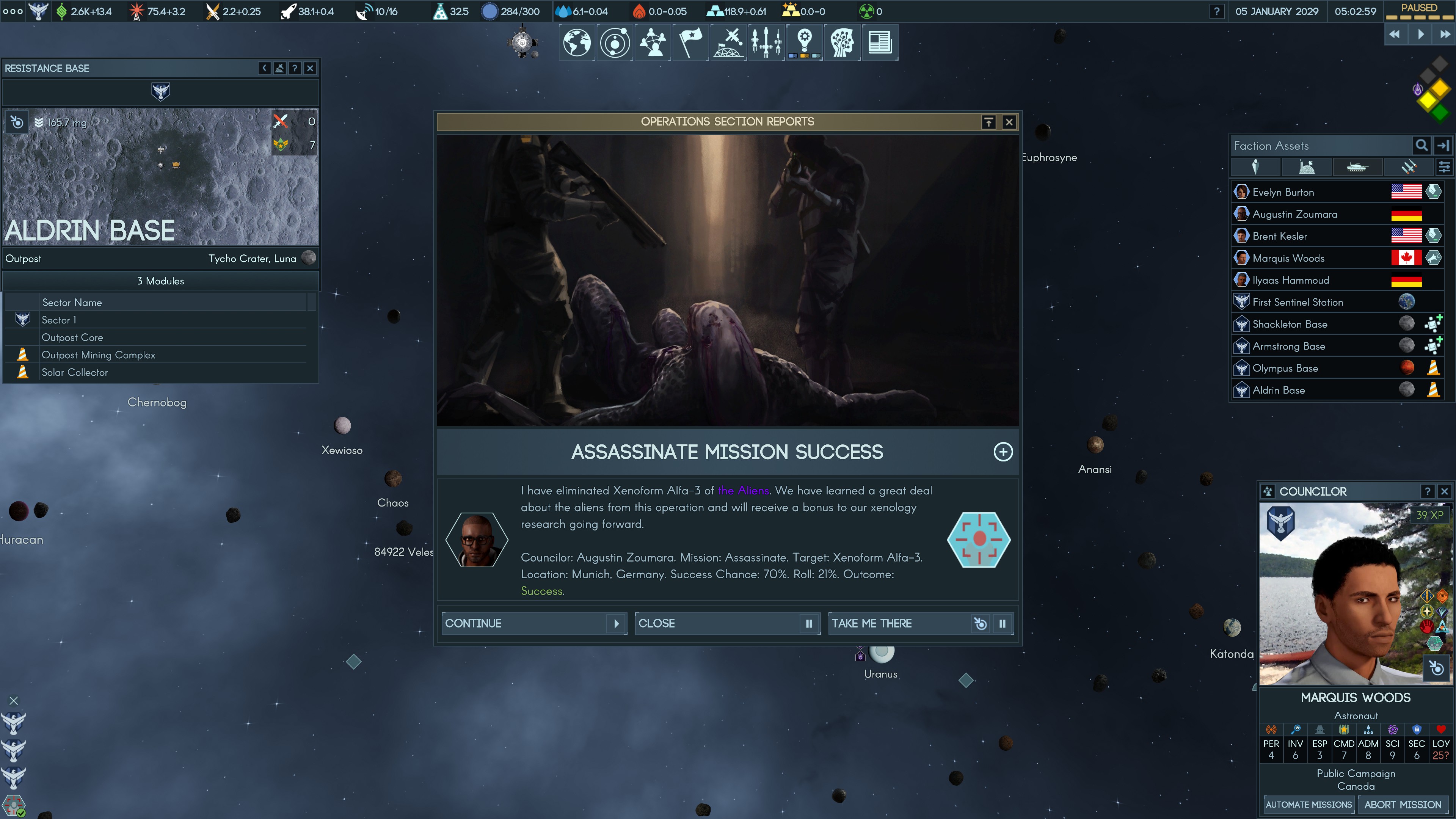
Everything that happens on Earth is pretty outstanding, really. The shadow war early on, surveilling enemy factions to learn more about them, keeping your own councilors loyal, and sending your operatives to eventually do battle with alien bioforms—I won’t spoil too much about how the ETs escalate things, but it gets really interesting—kept me engaged for dozens of hours. I can imagine a version of this game almost entirely set on Earth that really wouldn’t lose much of what I adore about it.
The Really Long War
And therein lies the problem. Because the whole back half is about industrializing space, mining Mars and the asteroid belt, setting up militarized space stations, building a proper star fleet, and turning a guerilla war against the aliens into a much less tense conventional one. And this can get to be a micromanagement nightmare in a lot of ways that Terra Invicta simply doesn’t have the tools to deal with.
Setting up my first mining bases on the moon and Mars, and even in the asteroid belt, was rewarding. Filling low Earth orbit with science stations feels interesting and meaningful. And launching my first homegrown warship was a major milestone that made me picture a room full of cheering mission control observers. But this phase of the war ends up stretching itself out into a cumbersome, repetitive slog with dozens of points-of-interest to track and manage using the inadequate UI. It took me more than 80 hours to complete a single playthrough as the Resistance, even being fairly familiar with the basics from early access.
I think it could stand to be around half that long. There is a faster game speed available, but it really just speeds up the pace of tech and the aliens executing their plans, which I think is the wrong way to go about it. I don’t think the pacing of the early game is bad at all. What’s really a drag is having to keep fighting when the war is basically won and the aliens are on the back foot. There’s some interesting Earth-side stuff to do during this time like removing greenhouse gases from the atmosphere and curing cancer and all that fun stuff, but I really wish there was more of a defined climax.
The tension that drives the entire story falls apart when the aliens no longer feel like the superior force. Some factions have a defined ending objective separated from this, like Project Exodus. And the ones working with the aliens don’t even have to bother with space that much because that’s daddy’s job. But for a faction like the Resistance, running cleanup, asteroid logistics, and fleet management only become more tedious as you become more dominant.
I don’t ship it
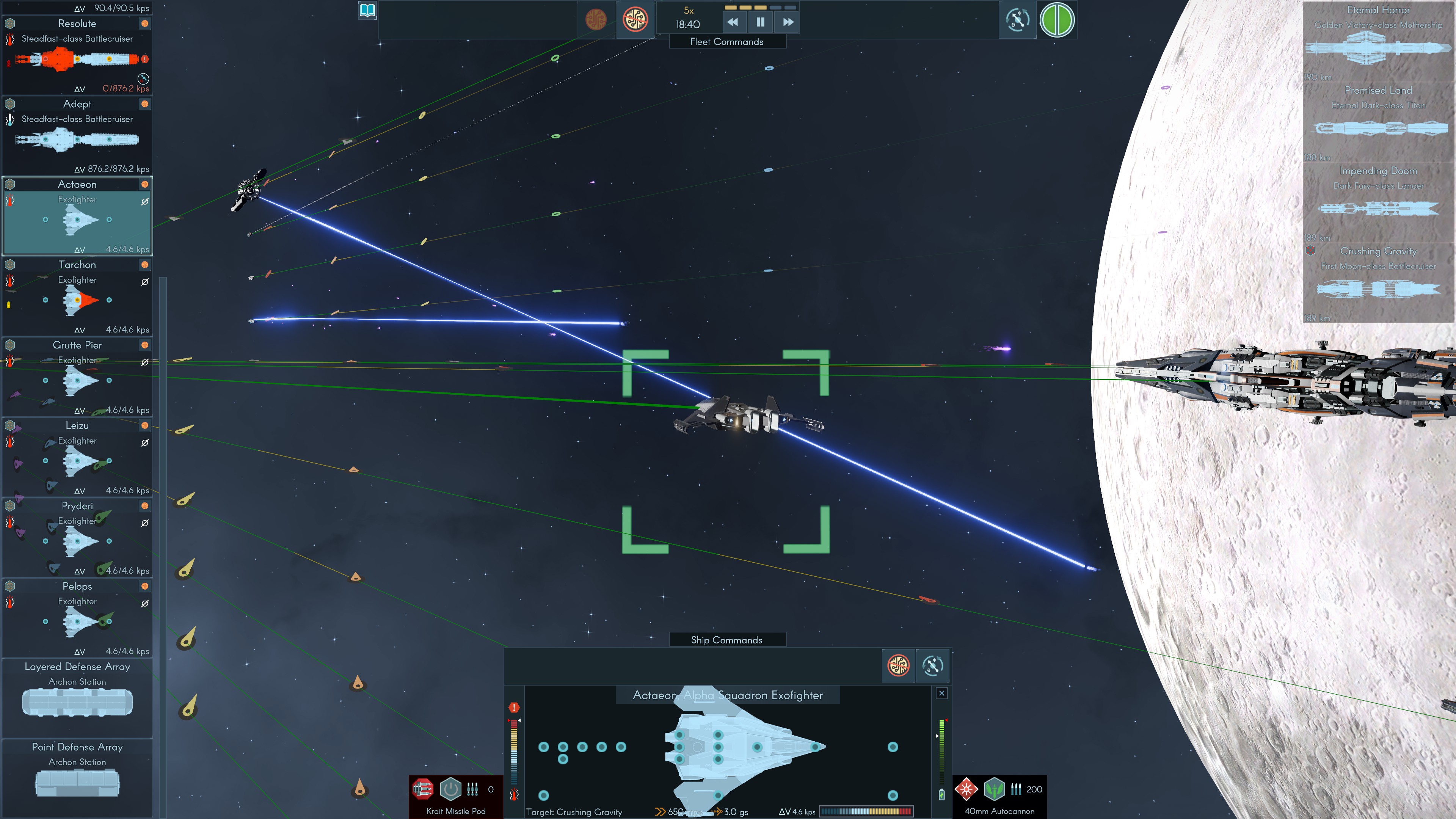
I also just don’t really care for the real-time space combat much. I admire the attention to detail, trying to present something closer to hard sci-fi with thrust vectors and directional armor that make every engagement feel like hurling spinning darts past each other and seeing who comes out in one piece. But I usually just auto-resolve them or set my ships to AI control if I want to watch some fireworks. The incredibly detailed flight and weapons controls are wasted on me entirely because I just don’t have the energy or desire to engage with them. The fact that it’s there for a different breed of sickos doesn’t bother me much, but the whole thing could be fired out the airlock and replaced with the auto-resolve button and I don’t think Terra Invicta would be any the worse for it.
That all being said, the parts that do work are so absolutely my kind of nonsense that I started and got many hours into multiple campaigns in the mere month Terra Invicta has been out of early access. It’s the type of game I can start playing at six in the evening and then look up and realize it’s light outside. The compelling scenario, interesting politics, and strong writing combine with its sometimes bewilderingly granular simulation to create what a social media follower of mine affectionately described as “the black tar heroin of grand strategy games.” And they weren’t wrong about that.
It’s bloated. It’s crunchy. It’s built out of dreams and hubris. But it’s special. I think it will be a long time before we see anything else quite like it.


