
I am in the dusty basement of Manchester cathedral. On the streets above me, there are police searching for anyone who would challenge the state. Someone like me. I am supposed to be working on a weapon to use against these fascists. It isn’t a gun or a bomb, it is a machine that eats books.
At least, that’s what I should be doing; instead, I’m searching for the final letter between the members of a love triangle of 1950s academics. I’ve tracked down all their trashy novels and papers on temporal dynamics, but I want to find the last bit of saucy gossip. Smashing the state can wait a moment.
There is a lot I won’t tell you about TR-49, Inkle’s latest puzzle game. I don’t want to ruin any of the epiphanies that lie in wait for you. But it is a treat for anyone looking to get all up in the personal lives of some long-dead fictional authors.
I know there are many of you curtain twitchers out there.
When you first awaken in that dirty basement, you are told by a voice over the radio that within the machine in front of you is a book. You must find a way to extract it from the machine’s archives before the police close in. However, when you turn the machine on, and its orange monochroma screens fizzes into life, you discover that its brain has become garbled. Whatever directory existed to guide users between the different entries in its databanks is corrupted. It falls to you to remap the archive and identify all the logged sources.
The sources within the machine are disparate. There are research papers with titles like Astral Perplexities, science-fiction novels retelling Arthurian legends with bug-eyed aliens, academic journals writing scathing takedowns of other academic journals, and personal letters sent between authors. It’s like trying to make sense of the papers littering a doctoral student’s cluttered bedroom floor.
You navigate between files in the archive by entering four-digit codes into the machine, selecting letters and numbers on a rotary dial. If the code you enter matches the address of a file then the machine’s monochroma screen zooms out and skates across the archive to your document, moving like a library microfiche machine. I’ve been playing on both my desktop and Steam Deck, and entering codes into this fictional machine has a delightful physicality to it. As you roll your thumb to select the letters and numbers the thumbstick clicks beneath your hands like you’re spinning a safe tumbler. It evokes the mechanical nature of those early 1950s computers, back when transistors were measured in inches not nanometres.
When you first land on a file in the machine’s archive, its title and contents are a mystery, encrypted and illegible. There is, however, always a note from the archivist who uploaded the document. These short blurbs offer clues to its identity. They might say, for instance, that it’s a book that was reviewed in the tenth edition of a particular literary journal. Find the journal in the archive and the archivist’s note appended to that file might tell you that edition contains a particularly scathing review of ‘Miracles of Water’ (not a real book in the game). You can now return to the first entry and pair its four-digit code with ‘Micacles of Water’ in your in-game notebook. Once successfully paired, the title and the extract will reorganise themselves into legible text and you will have returned a little order to the machine’s scrambled internals. Identify all of the machine’s sources and you might just piece together the mystery behind the device’s purpose.
A note on spoilers. The screenshots in this review and the paragraph below reveal some answers to early game puzzles. But there is nothing here from beyond the first 30 minutes in the game.
As you reassemble the archives, you will learn the rules of the machine. Recognising, for instance, that each log identifier follows the structure of the game’s title: two letters, two numbers. These stand for the initials of the author or publication and the year of its publication. Enter RS-83, for example, and you will be taken to a copy of Robert Louis Stevenson’s 1883 book, Treasure Island. From that identifier format, and the clues you spot in the archivists’ notes, you can begin to make leaps of logic. An early discovery is the publishing schedule of a literary journal. Once you know its publisher code and how often a new edition was published, you can jump forward to find new editions, uncovering a trove of titles, author names, and biographical clues useful for identifying further sources.
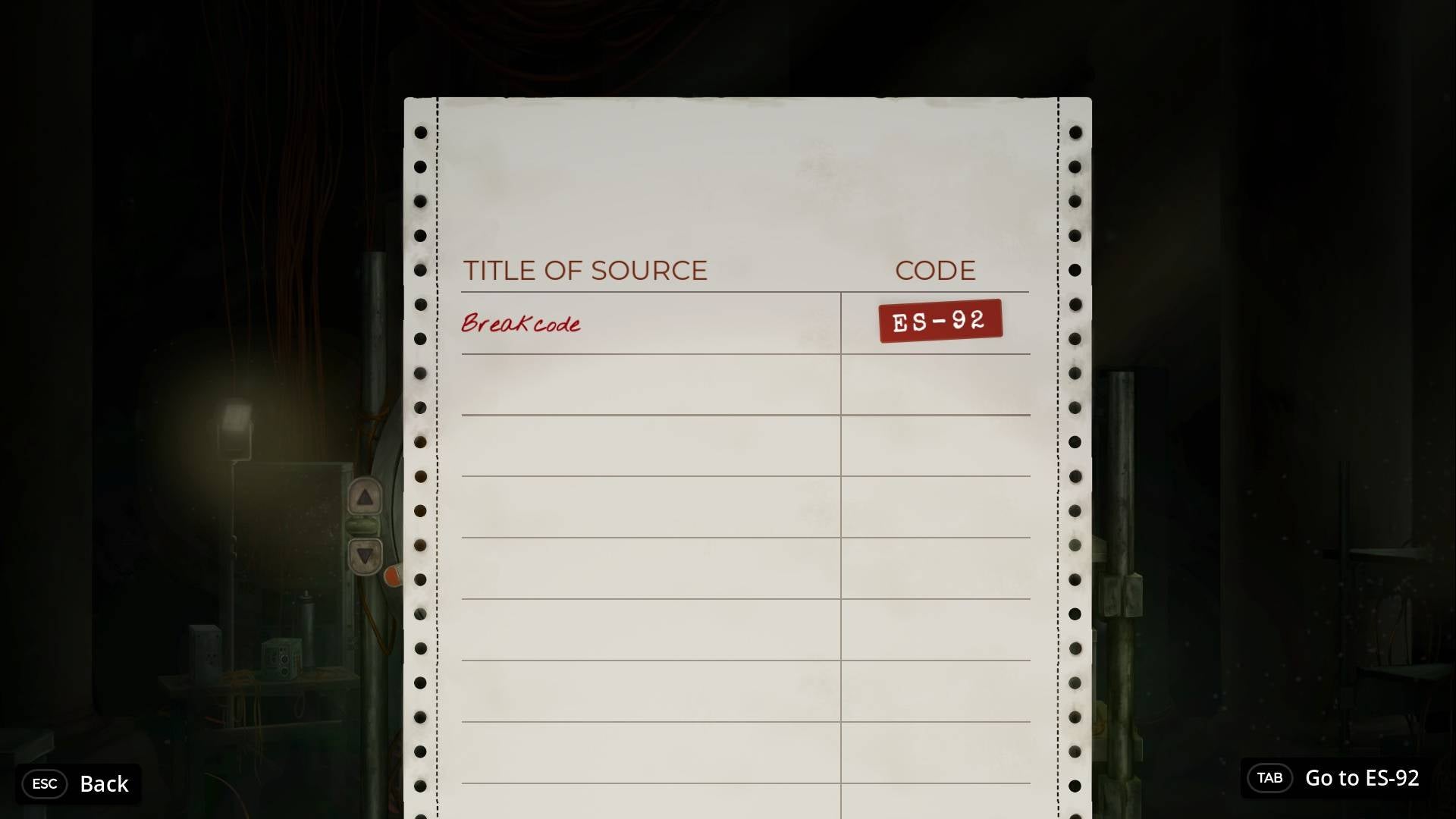
While Inkle provides an in-game notebook that automatically records titles, log codes, and creates brief biographies of the authors you discover, I also found myself scrawling across the tea-spattered pages of my own workbook. “She remarried?”, “Died 1971 but daughter pubbed open letter. Must find it”, “GA-00 = God Almighty year zero???”. As you piece together the archive, you catch glimpses of a literary scene filled with friendships and rivalries, admirers and haters, geniuses and idiots. There are references to their arguments in the archivists’ notes or direct call outs in the extracts you decrypt. I didn’t just want to know the function of the machine or discover the elusive text demanded by the radio operator, I wanted to know everything I could about their lives.
While there are a multitude of authors in the archive, your constant companions are the archivists: Cecil Caulderly, Beatrice Dooler, and their daughter, Aliz. Their notes hint at what’s in the files, helping solve the TR-49’s puzzles, but they also reveal the strain the work puts on Cecil and Beatrice’s relationship, the heavy responsibility Aliz feels in following her parents’ footsteps, and tease at mysteries within their own family life. Despite being a game filled with dead texts, the archive you’re restoring is alive with the people that created the library and wrote the sources that fill its digital shelves.
With the entire archive open to be searched from the start of TR-49 there is a sense you have complete control of your investigations. You could just start entering four digit archive codes and there is a chance you may stumble across an entry deep in the machine’s memory. You decide what clues to follow, and so your path through TR-49’s archive may be quite different to mine.

That freedom is a double-edged sword, however. As you can investigate any corner of the archive at any time, throwing out author designations and publication years with abandon, you can stumble into entries sooner than Inkle may have intended. I found the first pieces of a puzzle and leaped to the correct conclusion before I had the full context of the parts I was slotting together. Solving the puzzle ended the game, triggering a dialogue between characters which discussed significant details of the story that hadn’t been touched on at that point in my playthrough.
I’m being vague, as I don’t want to spoil any of the mysteries of such a short game, but I had so fallen into the world Inkle had created that to find myself unceremoniously stumbling out of the other side was disappointing. After hitting the credits you are given the opportunity to return to an earlier point and try a different approach, which I did, but then hit another ending I wasn’t looking for. There are still mysteries to uncover and sources to identify in my game, but after hitting two endings, it’s difficult to regain that same headspace where I was lost in its world.
I say I’m done with TR-49, but I never did find that final letter. Maybe, I will give the game one more go. After all, is the game really complete if I don’t find out what she said to the spurned academic after he wrote that journal article that was derided in the Literary Review?
This review was based on a review build of the game provided by developers Inkle.


