
With Dragon Quest and Final Fantasy, the Nintendo Entertainment System wrote the playbook for RPGs, for both turn-based and action. However, age catches up with all of us, and NES RPGs can be extremely difficult to revisit nowadays, especially since most of the good ones have received remakes or remasters that render the original obsolete. As important as they are, I wouldn’t really recommend revisiting most classics from this era… but exceptions exist to every single rule.
Now, I don’t believe a NES game needs to hold up to protect its place in history, as context matters in these situations; that said, knowing a game was great in 1987 doesn’t mean all that much in 2026, nor will it suddenly make you enjoy an archaic experience that just hasn’t stood the test of time. These fantastic role-playing games aren’t exactly timeless, but their age doesn’t hold them back from being thoroughly enjoyable nowadays.
For this article, I’m focusing on NES RPGs that have aged well and are still “near-perfect” today.
Lead Multiple Armies To War On The NES
-
 Image by GameRant; Source: Capcom
-
Image by GameRant; Source: Capcom
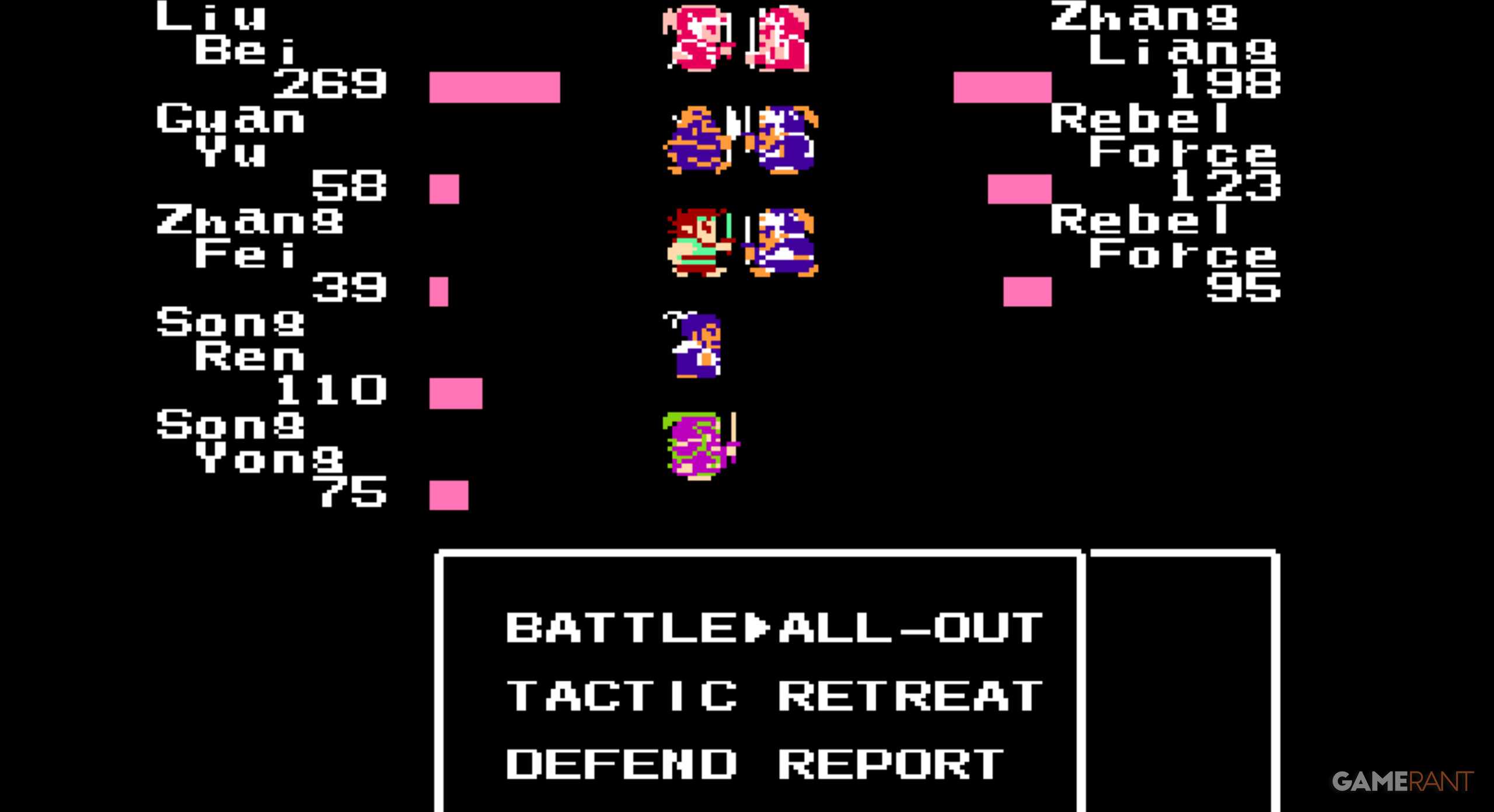 Image by GameRant; Source: Capcom
 Image by GameRant; Source: Capcom
A somewhat forgotten early release by Capcom, Destiny of an Emperor might be the most mechanically impressive RPG on the NES, one that didn’t simply settle for replicating Dragon Quest‘s formula. Based on Romance of the Three Kingdoms, this 1989 project really sought to capture the epic nature of the source material, to the extent that it was possible on a system that couldn’t show much more than top-down pixel graphics.
While represented somewhat as traditional HP points, Destiny of an Emperor shakes things up by defining a character’s strength by the size of their army. Your main fighters are Liu Bei, Zhang Fei, and Guan Yu, all of whom start with a smallish group of soldiers; however, as your militia grows, so does your power. However, each battle drains your soldier pool, meaning you really need to prioritize healing and tactics rather than just bashing the same button and hoping for the best.
Destiny of an Emperor also has a recruitment system that is kind of like Suikoden, along with tactical abilities, an intelligence stat, and even a fast-forward all-out attack that can destroy your army if used unwisely.
I will say, you probably need to be a bit familiar with Romance of the Three Kingdoms to really get anything out of this forgotten classic.
4
Dragon Quest 4 Is The Only NES DQ Game Worth Trying Today
You Might Hate It, But You Might Adore It
Look, we have to include at least one Dragon Quest NES game, even if all of them have better modern versions. Dragon Quest 4, aka Dragon Warrior 4, is not an exception, and I would recommend the PS1/Nintendo DS remake over the original; however, the 1990 release is still rock-solid, for the most part. Now, this entry is pretty notorious for its structure, as you spend the first 4 chapters playing through introductions for your party members.
This concept works well enough because each segment is unique and only lasts for a couple of hours, but it can give off the impression that you are constantly restarting the adventure. Chapter 5 introduces the actual hero and brings everyone together, leading to a roughly 20-hour journey. Now, Chapter 5 introduced another controversial mechanic: you don’t control your companions. Yes, you only command the hero, with everyone else doing their own thing and learning through trial and error.
Honestly, this mechanic might destroy DQ4 for most people, but it at least gives the game a novelty that almost none of the modern games have. Even the PS1 version adds manual combat control, so it’s not exactly like the NES original.
3
Sweet Home Is A Brilliant Horror RPG By The Masters Of Horror
Capcom Had One Heck Of An RPG Run On The NES

Yeah, another Capcom RPG. For a developer that isn’t known for the genre nowadays, Capcom produced some of its early success stories. Sweet Home is a bit of a unique case in general, as it’s a rare survival horror RPG, and it influenced the former genre more than the latter. You can easily trace this 1989 release to Resident Evil; in fact, Sweet Home even has the door transition made famous by the 1986 horror masterpiece.
Set in a single haunted mansion, you lead a group of characters who are all specialists; more importantly, they can also die, altering the story’s ending in the process. While you have turn-based combat, Sweet Home avoids the grind associated with early JRPGs, as leveling up isn’t as important as thoroughly exploring the environment and smartly collecting items (and assigning them to characters). While fairly straightforward, the game is pretty darn atmospheric for a NES title, and some of its creature designs are creepy (if not necessarily scary).
2
Crystalis Is A Nearly Perfect NES RPG
A Great Pseudo-Zelda, Too

While many RPGs copied either Dragon Quest or Final Fantasy, Crystalis set its sights on The Legend of Zelda. Nintendo’s masterpiece is an action-adventure game rather than a role-playing one, but SNK brought their own twist by adding stat progression, weapon levels, and unlockable elemental attacks. The setting is also quite unique, as it essentially falls under post-apocalyptic science-fantasy, a combination that was far from common on the NES.
Crystalis stands the test of time in most ways. The mechanics are still pretty great, particularly the combat, and exploration is quick and seamless. The world travel is generally fast-paced, more so than most RPGs from this era. If there is one element that hasn’t aged that well, it would have to be the level gating. You need to meet a threshold to fight bosses; otherwise, your attacks basically do no damage.
1
River City Ransom Might Actually Be A Timeless NES RPG
Time To Beat Up Some Thugs, Buy An Egg Roll, And Visit The Mall
-
Image by GameRant; Source: Technos Japan
-
Image by GameRant; Source: Technos Japan
-
Image by GameRant; Source: Technos Japan
 Image by GameRant; Source: Technos Japan
 Image by GameRant; Source: Technos Japan
 Image by GameRant; Source: Technos Japan
Really, this shouldn’t come as a surprise. From every genre that was popular on the NES, beat ’em ups have aged the best; hell, I could even argue that the genre peaked on the console. I would be wrong, but the fact that an argument could be made speaks volumes about the quality of the releases.
In an absolutely brilliant move, River City Ransom combines beat ’em up action with RPG elements, creating a fusion that actually allows both genres to shine. The real-time combat is fairly typical for the era; you have a basic punch and kick, along with the ability to pick up weapons. You unlock new moves by buying them and upgrade stats by eating or drinking, and you earn money by punching fools into next week. Really great stuff, and you genuinely feel like you are getting stronger along the way.
Although not a modern “open-world” by any standards, River City Ransom lets you explore its world by transitioning from screen corridor to screen corridor, creating an interconnected sandbox. Don’t get me wrong, the world is quite small, but it works well enough for this type of game.


