
When Nvidia comes out with something like DLSS 5, promising that AI can be used to make realistic videogames look even more shiny and real, it makes a kind of sense. Of course Nvidia thinks that’s what we want. When the same kind of promise comes from Roblox, it makes less sense.
Roblox Reality promises to upsample blocky Lego-like Roblox games like Grow a Garden until they’re photorealistic. Problems with the specific implementation demonstrated in the video are obvious. Maybe you’re not into the shimmery wetness of everything, and the way Grow a Garden’s menu has been interpreted as a sign in the world seems like an obvious problem. But, more fundamentally, the whole concept seems to misunderstand Roblox’s appeal.
Watch On
Alec Kieft, co-creator of hit Roblox survival game 99 Nights in the Forest, puts it like this: “If it’s a younger user who’s coming into my game and playing it, there’s not a lot for them to focus on on the map. There’s not a lot of detail in any of the structures or the foliage or any of that. They can easily parse exactly what is happening on the map. It leaves a lot more RAM for them to figure out the gameplay and the game design stuff.”


The lo-fi look of Roblox is not a bug. It’s a feature. As videogames get more detailed it becomes harder to tell what parts of them we can interact with, and we end up with ugly solutions like detective vision and yellow paint just to tell us what we can pick up or climb on, and what’s just background.
Nobody needs detective vision to see what’s what in 99 Nights in the Forest. “The graphics are very minimalist,” Kieft says. “That works very well for players, because you’re not shooting yourself in the foot with these overly complicated high-fidelity textures which people can’t run, but not only can they not run them, but now the user, the play base, is just overwhelmed.
“The more complicated Steam survival games that I’ve seen recently, the maps, they are gorgeous, but you can’t even see a rock on the ground because the texture beneath it is just so detailed, for better or for worse. And it turns out that people, really they’re OK with these more simple graphical styles.”
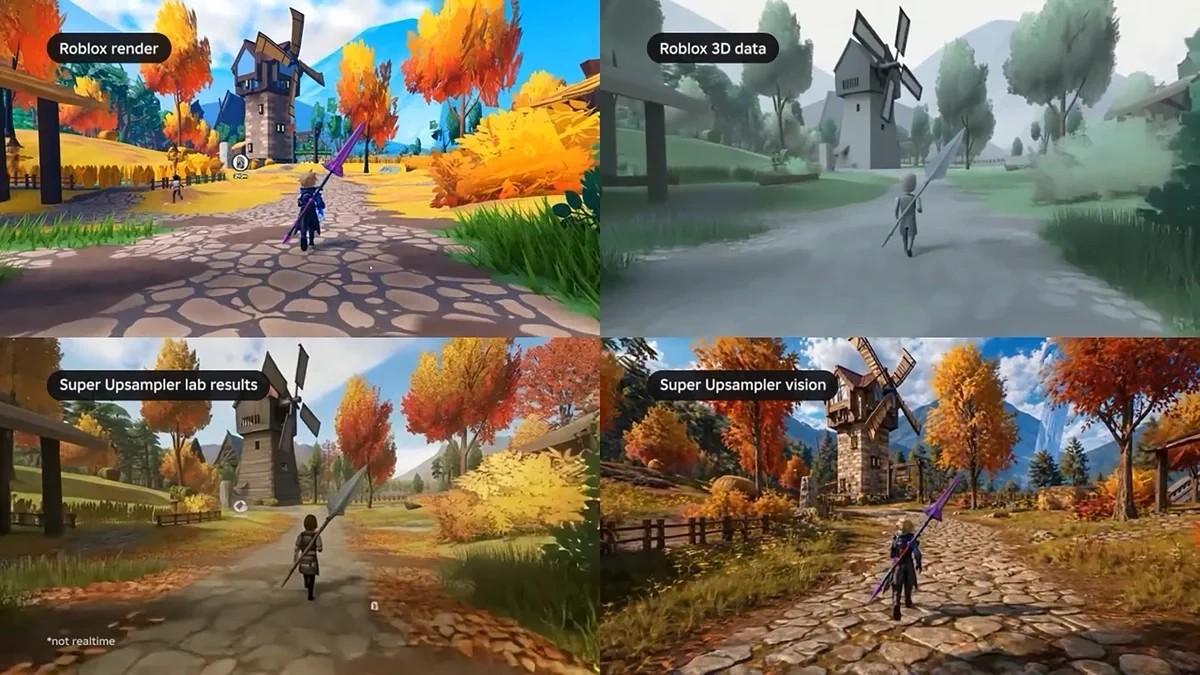
Roblox has already carved out a huge slice of the videogame audience without making its players beg their parents for a more expensive graphics card, but presumably the company sees the possibility of an even bigger audience that includes the people who really care about being able to see reflections in puddles.
“I think a lot of the moves Roblox has made recently are trying to prod everyone in the direction of, like, why don’t you try making a high-fidelity driving game or something like that?” Kieft says. “They’ve been very intentional with that sort of thing. I think that, right now, I’m not interested in making a high-fidelity driving game.”
But while Kieft doesn’t have any interest in it himself, he sees the possibility for a shift to happen. “All it needs to do is attract one person who carves out a Roblox-specific high-fidelity genre, and then suddenly, more people are drawn to that genre, and you’ve now got a whole community of players on the platform that are looking for this sort of thing,” he says.
“I can sort of understand what the long-term objective is, but I think upscaling 99 Nights to high fidelity is probably, I would guess, it’s going to be more of a niche audience that will be interested in even trying that. I don’t think that your average player right now wants to do that.”


![Demeo x Dungeons and Dragons Battlemarked A Golden Opportunity [RUNE] – MaxBit](https://i0.wp.com/gamepcfull.com/wp-content/uploads/2025/12/Free-download-demeo-x-dungeons-and-dragons-battlemarked-gamepcfull.jpg?w=100&resize=100,100&ssl=1 "Demeo x Dungeons and Dragons Battlemarked A Golden Opportunity [RUNE] – MaxBit")
