
It’s those bloody typewriters all over again. Developer Wych Elm Games’ Silver Pines is fantastic in a whole bunch of ways, from its woozy small-town ambience to its mix of taut survival horror and exploratory Metroidvania. But from the very first moment I saw its save system, its please-insert-coin phone box demands, I knew our relationship was going to be a fractious one.
Silver Pines begins, however, in the gloom of a 1950s diner; lights off, windows boarded, as the titular town awaits an oncoming storm. You are private investigator Red Walker, but your jittery demeanour and Valium drawl suggests you’re equally oblivious to the whos, whats, and whys of it all. Out in the parking lot, a phone box rings; there’s cryptic talk of a missing musician and a motel room. Then, the scene set, it’s onward into the heart of the town.
Silver Pines dabbles in neo-noir and psychological horror, but its debt to David Lynch – Twin Peaks in particular – is unmistakable. If the 50s diner opener wasn’t enough of a tip-off, it’s not long before the town’s cast of beautifully rotoscoped oddballs begin making themselves known; enigmatic conversations unfurling in awkward non-sequiters. Then later: as Red passes through a suspicious door, reality seems to bend entirely, taking him to a dingy nightclub bar somewhere out of time. There’s no talking giant, but we do get a song.
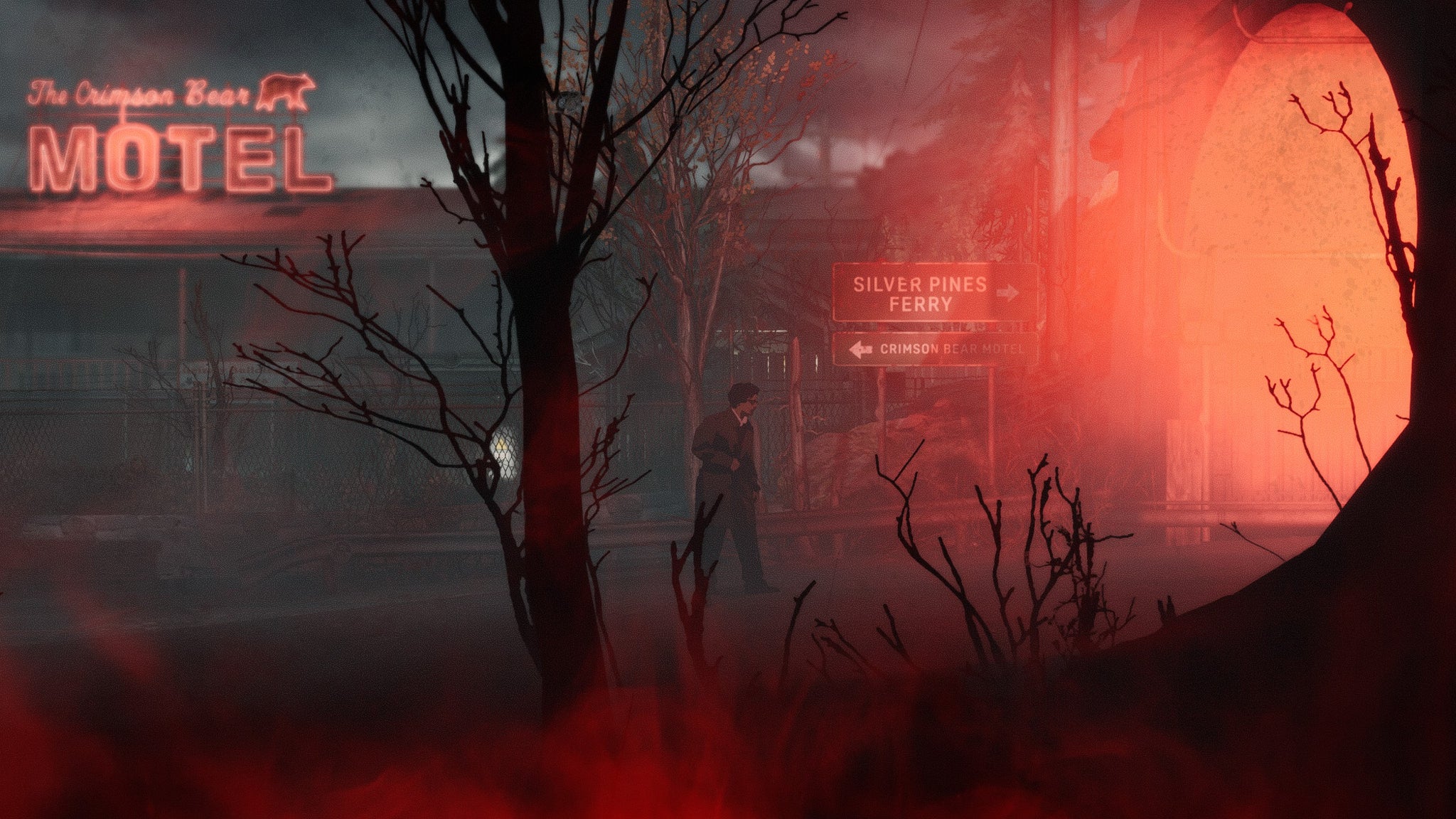
Twin Peaks’ iconography has been borrowed and repackaged so much in the 36 years since its landmark arrival, it’s hard to pay it homage without ringing the creative death knell. So it’s testament to Silver Pines that, for all its hat-tips, it still manages to find a mood that feels like its own. Granted, its one that exists at the intersection David Lynch and Silent Hill (itself indebted to Twin Peaks) but the town’s ambience – a kind of dishevelled melancholy – is an affecting one. Its world, built from layers upon layers of strikingly painterly 2D artwork, is drab and desolate; perpetually dank and lost in artfully controlled shadow. Its sorrowful monstrosities shimmer like a suggestion. And beneath the wind and the rain and the wailing of lost souls lies an ambient synthline so slight the soundscape skirts close to ASMR.
That, though, is entirely fitting for an adventure whose pace is such a languid one; as woozily unfocused as Red seems to be when he first picks up that phone. That’s not a criticism though. Silver Pines isn’t afraid to create space for its insidious ambience to slither in. There are pockets of staccato violence, absolutely, but between the deliberately stilted gunplay and awkwardly stumbling melee its primary rhythms are exploratory ones.
Which is where the Metroidvania stylings come in. Silver Pines, the town, is a vast, interconnected space: drizzly exteriors lead to gloomy interiors that branch out to new pathways or double back to previously impassable ones (you’ll be hearing Red muttering “The door opens from the other side!” in your dreams). Sometimes you’ll stumble across a perfectory puzzle, but progress most often requires identifying which part of the map, perhaps a location first seen much earlier, might succumb to new tools: a boxcutter that opens up passageways sealed with plastic; a pistol that can shatter rusty padlocks. And a shout-out to one of my favourite underused Metroidvania mechanics – the ability to photograph points of interest and pin them to your map, serving as reminders for future you.
It all makes for a haltingly ambulatory flow that suits and serves the quieter mood. But truthfully, having hit the five-hour mark, I’m finding the whole thing a bit of a struggle as I grapple with its intentional throwback design. Beneath Silver Pines’ sumptuously bleak presentation lies an ancient heart. And while I’m certainly not criticising a deliberately old-school adventure for playing it old-school, it is making me thankful the genre’s moved on.
Silver Pines, like most survival horror, builds tension through scarcity and impermanence, offering thrilling glimpses of power only to take them all away again: bullets are limited, melee weapons break, and the resources needed to restore them are equally few. Without all that, your only hope of survival is a stumbling duck-and-weave. But Silver Pines spins a particularly punishing web, tying everything to the finite number of coins left out in the world. Ammo, duct tape, health items, and so on are rare finds on the map, but comparatively plentiful in vending machines. However, coins are also the currency you’ll need for phone box saves, meaning every choice you make feels even more perilous; the perpetual threat of a death spiral.
And the truth is, as much as I love survival horror, I’ve always hated limited saves; not just the push-your-luck stresses they invoke as I’m forced to decide if I dare risk – for instance – my last Resident Evil typewriter ribbon, but the steadily deflating atmosphere when my luck runs out and I’ve got to do the same section all over again. It’s a problem modern survival horror still grapples with, of course, but, by jettisoning the arbitrary restrictions of limited save currency, they’re able to manage a more sustained momentum.
And by binding its survival systems so tightly – the threat of weapons failure, the threat of death – under the guise of coins, Silver Pines has made me even more obsessive about my saves, even more cautious about frivolous spending. And it’s turned mood into mechanisms. I’m min-max route plotting, enemy tracking, bullet counting, and limiting my box cutter swings – so much energy spent on mental spreadsheet-building I’m no longer immersed in the mystery of the thing. And the open-ended structure does rather exacerbate the issue: its long, slow stretches of nothing followed by unexpected deaths make redoing bits particularly wearying.
Of course, it’s not Silver Pines’ fault it’s igniting my old-school survival horror PTSD. And I’m fully aware there are sickos out there who love this kind of thing; the queasily unshakeable threat of spiralling disaster and the harsh punishment when calculations are off and disaster finally comes. But you know what? I certainly respect Silver Pines, even if we don’t always get along. It’s a gorgeously woozy exercise in mood, with a fishing line mystery that – for all my grumbles – just keeps pulling me on. Not for nothing is its enigmatic bar known as The Rabbit Hole, and as the search for Eddie Velvet continues, here I am; lost in the warrens again.


