
CD Projekt Red alumni create a familiar dark fantasy adventure, but one with bold and provocative ideas of its own, that’s mostly, enormously successful.
There’s a lot that’s been made of the similarities between The Witcher 3 and The Blood of Dawnwalker in the lead-up to the latter game’s release. Why? It’s made by the same director, in Konrad Tomaszkiewicz, plus many former people from CD Projekt Red for one. But also because it’s clearly trying to evoke a similar experience.
There are many times running around Dawnwalker’s world where it feels uncannily like The Witcher’s. It’s the tone of the world, which is earthy and touchable, as historical as it is fantastical, and it’s in the way the world reacts to you as a player, with people blurting crude observations as they voice the realities of tough existences. It’s there in the brutality of the world too, which can be unflinchingly cruel, just as it’s there in the Polish folk music that accompanies it, or the similar user interfaces, the similar gameplay. Even the dark, supernatural themes are reminiscent.
These are some of my favourite things about The Witcher 3, a game that’s become legendary in RPG terms, so Dawnwalker launches from a powerful springboard. But it’s risky to be compared to a great. Thankfully, Dawnwalker manages it: it meets that high bar, if not quite raising it. And it does it while bringing new ideas of its own.
The biggest of these new ideas is you are the eponymous Dawnwalker. You’re a young man called Coen, living in Eastern Europe’s Carpathian Mountains, in 1347, who’s about to be partially turned into a vampire. Something prevents him from transforming all the way, so he’s still able to walk and explore in sunlight, and this duality means he effectively has two forms: vampire and human, and they change automatically relative to whether it’s day or it’s night. Having two forms allows the game to effectively give you two characters in one, which provides much-needed variation in a many-hours open-world role-playing game such as this – something, since I’ve already referenced The Witcher 3, that The Witcher 3 suffered from.
This is true of both combat and exploration. By day, Coen runs around the world like everyone else – on foot. But by night he has no such restrictions. He can walk up walls and cliff-faces and teleport across rooftops. And nowhere is this more apparent than in the game’s central city of Svartrau, which has densely packed houses and therefore rooftops, which night-time Coen can run around on and hunt from above on, whereas day-time Coen has to explore on foot below.
I love this. This approach not only uses more of the game’s world than if rooted to the ground, opening up a rooftop playground for you, it gives the game more layers of activity to pursue. Some things you can only do at night because they require your enhanced movement capabilities, whereas some things you can only do in the day because you need to be a part of the waking world for it. Moreover, it simply feels cooler to teleport around, or slide down a huge wall with claws, or stand on a vertical wall with gravity shifted, than it does on the ground.
Which leads to a pertinent question: why not just be a vampire all of the time? Well, to start with, you can’t be: it’ll automatically change you when the sun rises. Secondly, there’s the issue of time, which I’ll come to in a moment. But thirdly, you’re also extremely capable during the day, just in different ways. You aren’t only a vampire, you see, but a witch of sorts. By day you have extremely powerful spells and abilities that you can’t use at night, such as the ability to slow time while speeding up movement to bomb around the world like The Flash. But also, to talk to dead people, and also to perform rituals. These mutually exclusive witchcraft and vampire abilities are linked to skill trees, gelled by a skill tree in the middle – swordsmanship – which is relevant to both forms.
The other big idea, as referenced, is time. In Dawnwalker, you control it – you determine when time moves. It doesn’t just trickle away on its own; day never turns to night without you okaying that transition. You can run around the world buying and selling and fighting the odd pack of wolves and time will effectively stand still. You move time deliberately by performing quests; every quest has a time-cost associated with it, denoted by segments on a time gauge. Should you come across a small and relatively insignificant quest like helping someone out in the world, then, your time gauge in the top corner will ping to alert you to a possible time advancement. Bigger quests demand more time depending on the activity at hand. Even unlocking new skills can cost time, though mostly more powerful skills later on. The game does this because time is intrinsically linked to the game’s story, whereby something has happened to Coen’s family and he has 30 in-game days and nights to sort it out.
This ever-present clock, of sorts, shapes the game, and I’ve seen concern out there about it. But to begin with, and for a lot of the adventure, it’s more of an existential threat than a pressing one. You’re aware that you’re spending a limited resource but there’s so much of it early on that it doesn’t seem to matter. There’s plenty of time to do things. But time does start to dwindle as you finish quests and start spending time on skills, say. Days will turn into nights that will turn into mornings; 30 days becomes 20 becomes 15. It creates a low-level kind of panic, which I think is nice – time passing is not something I normally notice in a role-playing game. How many days passed in Skyrim? I couldn’t tell you. There, the world waits. Here, it doesn’t, and I appreciate that – it feels more believable, and it makes time a present factor in the world. Characters say “come back tomorrow” and it means something. Can I afford to? But time also creates a bit of a problem as well.
Famously, Dawnwalker doesn’t have a main quest that leads you through the game. It has an overarching goal, as mentioned, but how you tackle it is up to you. Dawnwalker’s prologue ends and the valley of Sangora stretches out before you and the game goes: “off you go”. Theoretically, you can go anywhere. In fact theoretically you can go and try to rescue your family and confront the final challenge, there and then, though in reality, you probably can’t. Areas of the world are higher level than others, which will either kill you or dissuade you from being there early on, so in this way the game invisibly organises itself. There’s also gentle direction from important questlines running through the world. There is an invisible hand steering you around, clearly, which I’m grateful for. But it is up to you when to take the final challenge on.
I decided to test this with 15 days to go – the half-way point, I suppose. I felt I’d tipped the balance of power in the game and was winning fights comfortably, so on Fair difficulty, the game’s equivalent of Normal, I approached the final challenge. I was flattened; I tried a few times and had some success but ultimately met the same end. The enemies were higher level and I left with the distinct impression I wasn’t supposed to be there yet. Fine; that’s what I’d hoped for – any excuse to go back out into the game’s world.
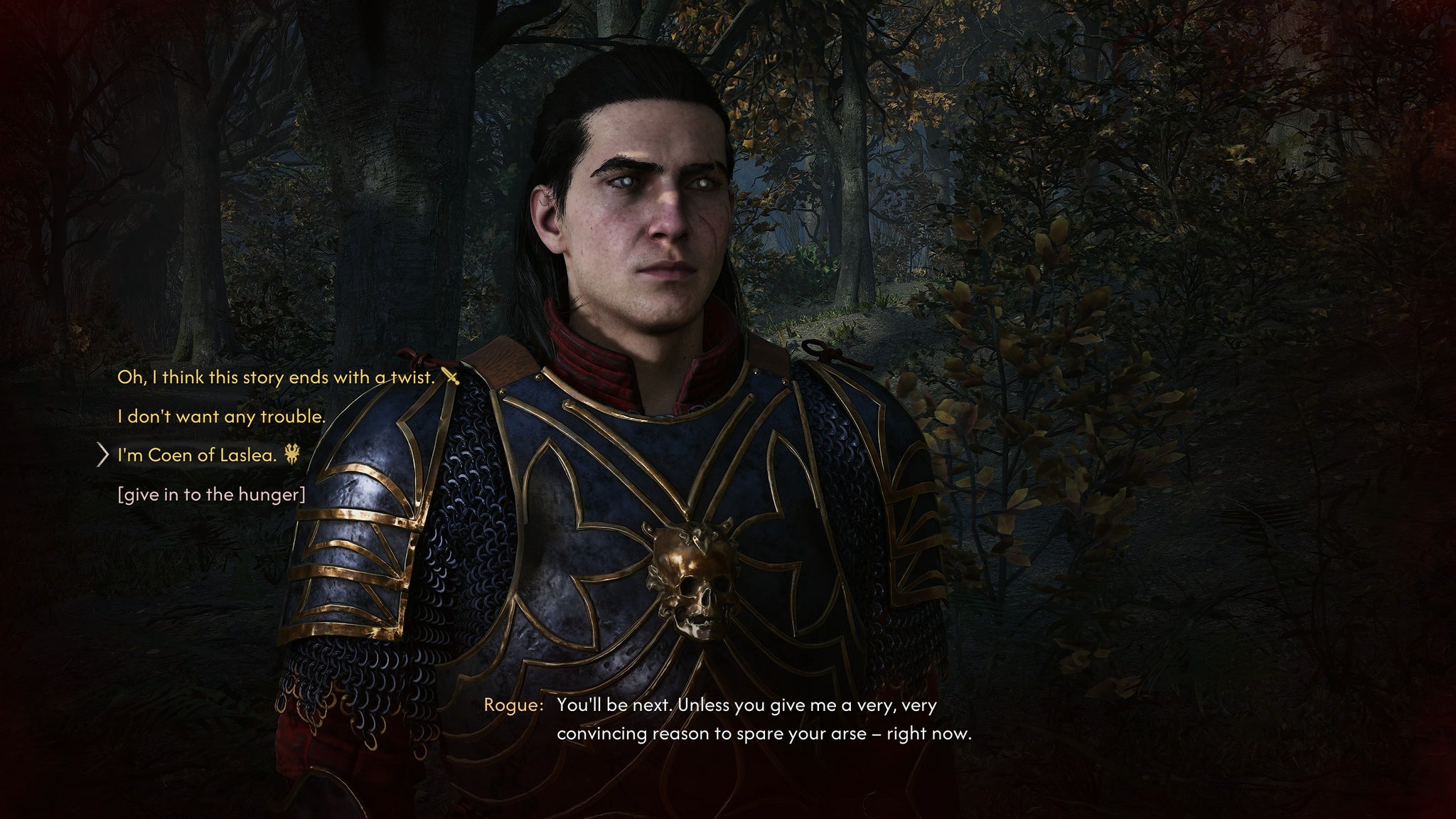
But then I tried again in vampire form and unexpectedly had a very different outcome. There’s a slight imbalance between the two forms in this regard. Eventually, when you have a really powerful sword and really powerful witchcraft abilities, and sword abilities, it probably levels out; but for me at that point, I was much more potent as a vampire. I had some life-gain abilities that meant I lasted longer in combat, and to my surprise, I cleared one battle after another until I was dropping bosses and beat the game. It wasn’t easy – it took a few attempts especially on the final, final encounter – but I eventually succeeded without any of the allies I was questing to collect.
Naturally, I felt proud about this, and I got an achievement to underline it, but the jarring issue I had came in the epilogue where it became clear I’d missed chunks of characters’ story and of the game. I mean, clearly – I’d done about half of what was out there. This jarred because narratively, shouldn’t it be a good thing that I saved my family as fast as I could? Except here, the game was also intimating: you missed some stuff, Bertie – maybe you could have used more of your time? That’s a clash between the narrative set-up and the RPG nature of the game, I believe. It also concerned me that I’d finished the game much earlier than expected. What do I do now?
I’m not sure where I fall on this even now. I reload a save and go back into the world and try to ignore the fact I’m capable of finishing it, and boost the difficulty, but it does play on my mind. Nonetheless, I admire the audacity of offering this possibility at all. The question of “When do I attempt the end?” is far more interesting to me than “When will the game lead me to the end?”, and all of the permutations referenced in the epilogue I’m sure will make the conversation around “What did you do in the game – which ending do you get?” a lively one. This is probably a game to play a few times.
Plus, the moment I went back out into the world, I was immediately rewarded by a superb quest I would have missed otherwise. Uniformly, they’re excellent. All of the quests seem to involve multiple stages and either have interesting or eccentric characters to explore, or mature subjects to explore, or both. They are genuinely interesting; experiencing them is their own reward – though it helps that every activity in the game is materially very well rewarded as well.
The quests can be this way because the mix of open-world activities alleviates the need to have any filler. There’s a variety of activities you come across while exploring the world that you do there and then – there’s no back and forth, unless one activity leads to another quest. The only repeatable kinds of activity tie into a clever notoriety system, whereby each area of the valley is sort of ruled by one of the big boss’ generals, so the things you do there – usually against them – end up angering them. There are various different things you can do to this end, but once you do enough of them, they’ll come for you, which is great. They’ll seek a confrontation somehow. It gives a great sense of purpose to exploring the wider world, while divulging backstory about these generals you otherwise don’t get, and there’s a lovely potential pay-off if and when you defeat them.
But for all that there’s a good mix of things to do in the world, a sense of repetition does creep in. Visually, effort has been made to vary the valley and to take you to other places, but it’s still a bit samey. There’s also only so many of the same kinds of enemies you can fight, be they soldiers, animals or otherwise, and though it takes a while to acclimatise to Dawnwalker’s directional-block combat, eventually you will, and that’s when a damage spongy element to enemies becomes mildly gruelling.
I should say that you don’t have to direction-match blocks – you can “omniblock”, as the game calls it – but if you can match the direction, you’ll be rewarded, usually with stamina refreshes, but later by skills that trigger from perfect blocks. There’s a lot to like about this approach. Enemies never attack at the same time, which was a huge annoyance in The Witcher 3, so it’s possible to take down large encampments of soldiers providing you pay attention to the directional indicators as blows come in. There’s a sort of rhythm-action element to it that’s always baseline entertaining – a battle with your own reflexes. But as the challenge of succeeding drops off, and the novelty of new enemies subsides – and as you grapple with fiddly annoyances like flipping between d-pad-based hotbars, and automatic enemy lock-ons changing if you crowd control one of them – combat can become a slog.
Changing difficulty helps this. Especially – and this might sound like a stretch but it’s not – upping to the highest difficulty in the game, Duelist. This makes enemies more aggressive and has them attack faster (big-up games that change enemy behaviour rather than just health bars and damage) but it also lowers their health. It makes them more glass-cannony. It takes away directional attack indicators as well (something you can turn on and off at will on other difficulties), but this is not as hard as it sounds like to deal with; it even puts your eyes more on the action than the indicators, which adds immersion. Duelist difficulty is doable, then, eventually, and it alleviates – along with powerful skills and abilities – the slog. Consider it!
There are ideas here about how to do things differently, then, and though they don’t always work flawlessly, I appreciate the intention. This isn’t just a reskin of an existing idea. Presentationally, it wouldn’t be enough if it was, to be blunt. Visually it’s handsome enough: characters have good detail and expressive eyes, and the game’s attention to period detail is especially commendable. The way it throws evening sun on wattle and daub houses in Svartrau, or the way the moonlight twinkles on tiled rooftops, or the morning sun chases away the shadows of the night: these moments are endlessly coo-able. But it isn’t a generational leap, if that makes sense.
I’m also incredibly impressed with the voice-work of the main characters in the game, with Coen’s English-voice actor Will de Renzy-Martin in particular, who’s softly spoken delivery reminds me of Tom Hiddleston and is endlessly listenable. Andrew James Spooner as Brencis is another stand-out, as are the actors who play Lacra and Anca – two central characters in the game. Lacra in particular is superb, armed as she is with pithy remarks, purring sensuality, but also vulnerability and depth. Her voice actor hasn’t yet been revealed, surprisingly, but I’m trying to find out who it was.
But, holistically, the Blood of Dawnwalker is more than these things. This is an RPG daring to do things differently, and a lot of what it does works. It’s in little details like blacksmiths that can level up your old gear to match your new gear that I feel RPG expertise and experience from Rebel Wolves – that I feel understanding of how RPGs might play that little bit better. Then it’s writ large in the way the game is structured and in the fundamentals of how it plays. In Coen, Rebel Wolves has discovered a dual-aspect hero that provides wonderful and welcome variation. In a time-limited and structureless world – although not quite as structureless as it might appear – it’s discovered a way to make people pay more attention to the things they do, and be more present in their own adventures. I’m not sure all of the elements quite sing in perfect harmony yet, but it makes me extraordinarily excited to see where this studio goes from here. The Blood of Dawnwalker is a hell of a debut.
A copy of The Blood of Dawnwalker was provided for review by Bandai Namco.


